How to Build an SEC Filing Agent Without Naive RAG

Build a navigation-first SEC agent that selects the right filing, inspects its TOC, reads exact sections, and returns passage-level citations.
How to Build an SEC Filing Agent Without Naive RAG
Table of contents
- Short answer
- What problem should an SEC filing agent solve?
- Why are SEC filings different from normal documents?
- Why do fixed-size chunks fail on 10-Ks and 10-Qs?
- What should replace naive RAG for SEC filings?
- How should an SEC filing agent answer a question?
- What does SEC filing analysis with AI look like with MCP?
- Example: how should an SEC filing agent compare NVIDIA risk factors?
- Why does navigation-first retrieval improve SEC filing agent answers?
- Where does AlphaCreek fit?
- What architecture should you use in production?
- What mistakes should SEC filing agents avoid?
- When is naive RAG still acceptable?
- FAQ
- Methodology and update context
- Final takeaway
- Get started with AlphaCreek
Short answer
If you are building an SEC filing agent, do not start by asking how big your chunks should be. Start by asking how the agent should choose the right filing, inspect its structure, read the relevant sections, and cite the claims it makes.
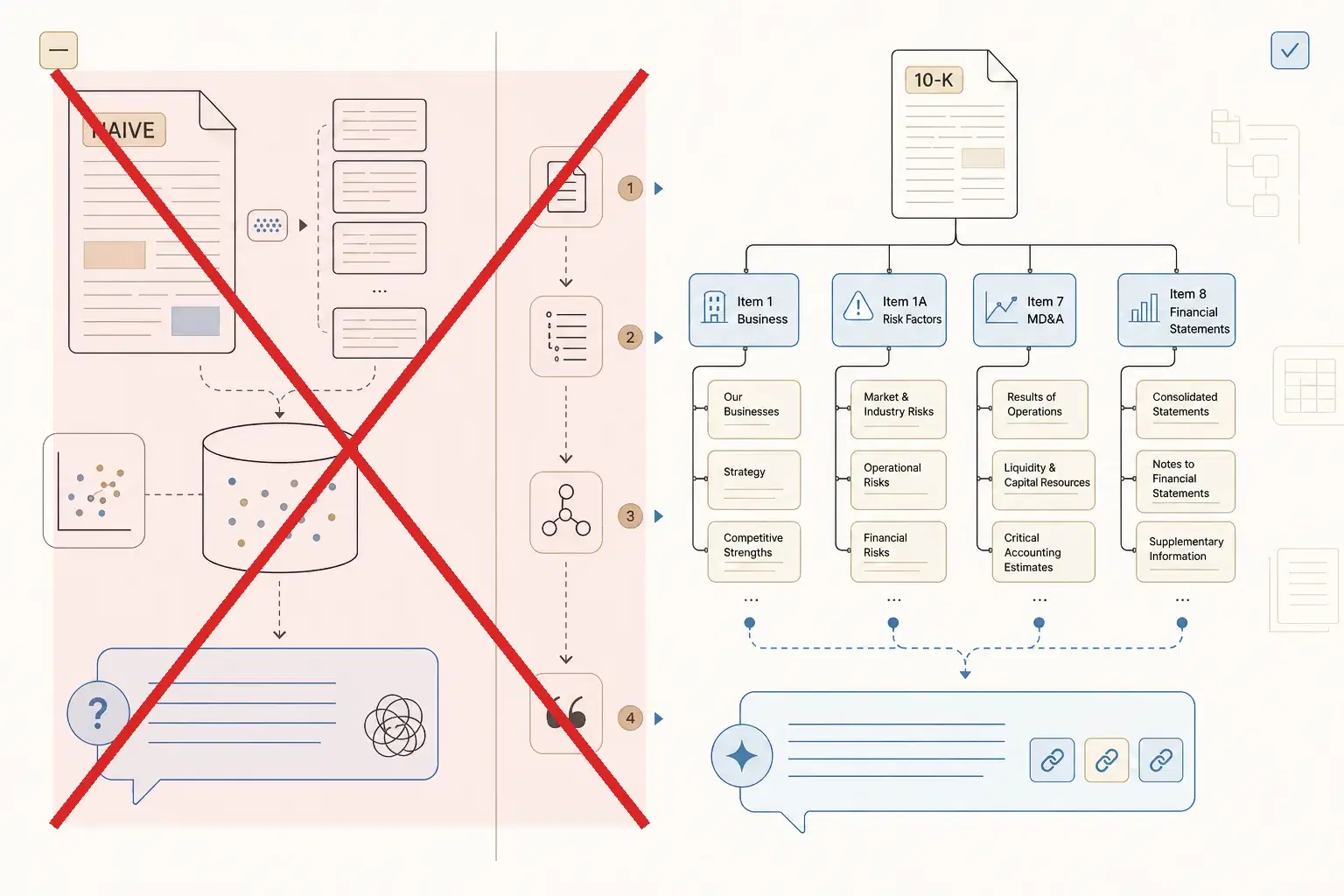
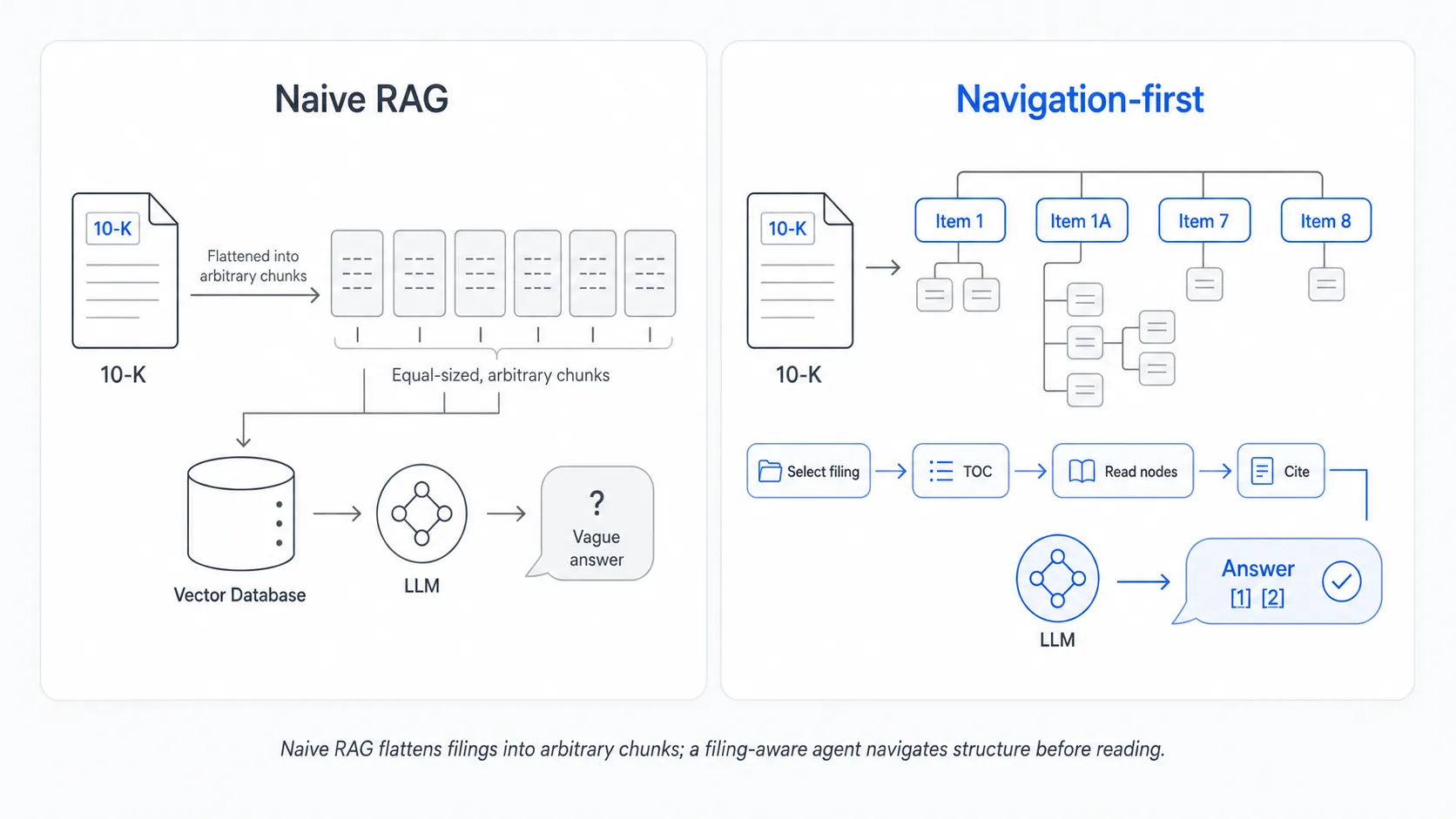
Fixed-size RAG chunks are a weak source unit for 10-Ks, 10-Qs, and other SEC filings because they flatten structured disclosures into arbitrary text blocks. An SEC filing agent should retrieve like an analyst reads: select the company and filing period, inspect the table of contents, navigate to Item 1A, Item 7, Item 8, notes, or tables as needed, then read the smaller titled sections inside those Items instead of loading the whole Item when it is not needed.
Practical takeaway: Build SEC filing retrieval around filing identity, table-of-contents navigation, fine-grained section reads, table-aware context, period control, and stable citation URLs. Vector search can still help, but it should support the workflow instead of replacing it.
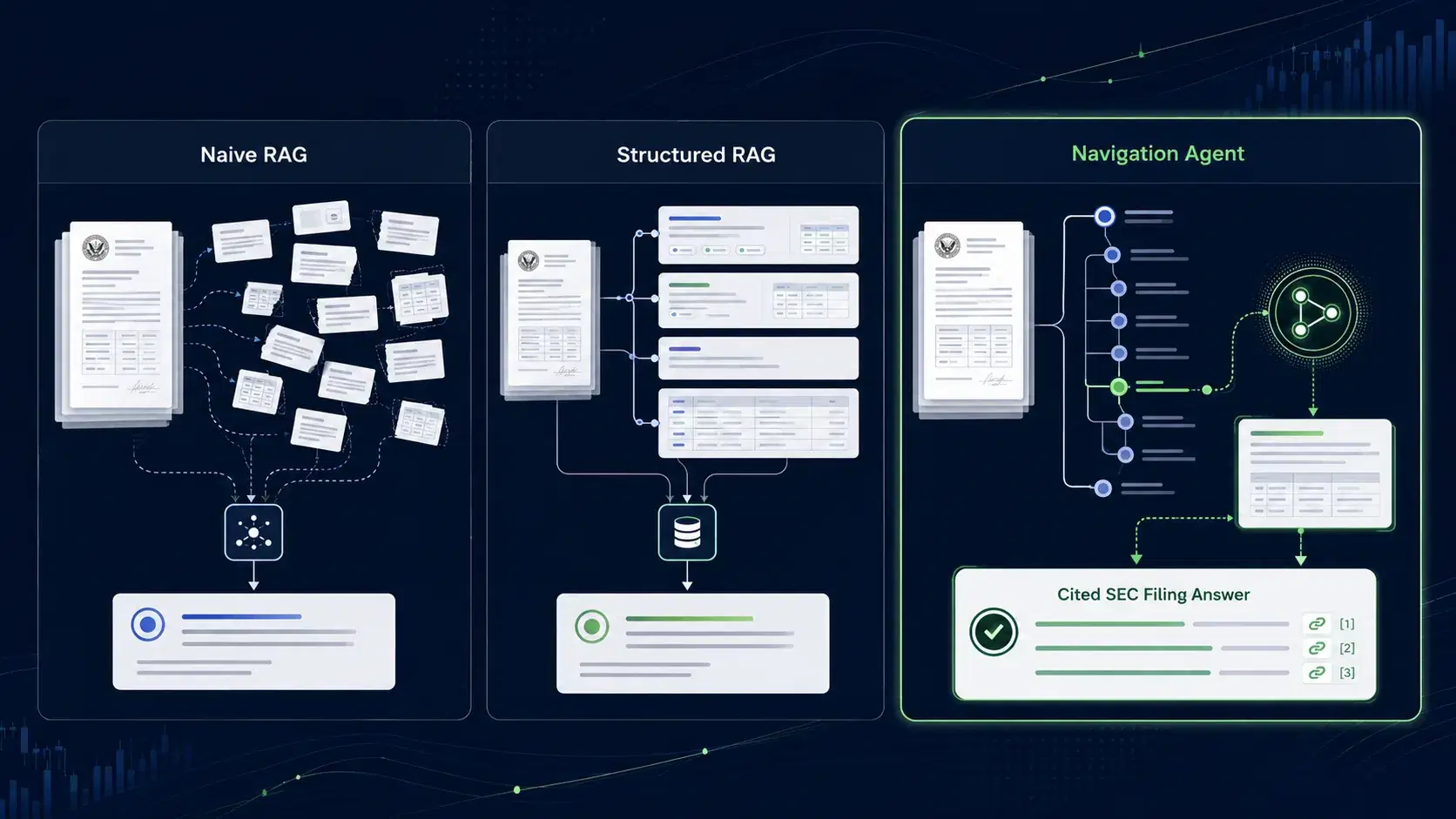
Naive RAG flattens filings into arbitrary chunks; a filing-aware agent navigates structure before reading.
What problem should an SEC filing agent solve?
An SEC filing agent should help users answer source-sensitive financial questions from company disclosures. Those questions often depend on the filing type, fiscal period, section, table, note, and exact wording of the disclosure.
Examples include:
- What changed in the company's risk factors compared with the prior 10-K?
- Why did gross margin change this quarter?
- How did segment revenue mix evolve over the last three filings?
- What does management say about liquidity and capital resources?
- Which accounting assumptions matter for this metric?
- What source supports this specific claim?
Those are not generic document search questions. They are analyst workflow questions. The agent needs to know where it is inside the filing before it decides what text to read. For a product example of this workflow, see SEC filing analysis in OpenBB.
Why are SEC filings different from normal documents?
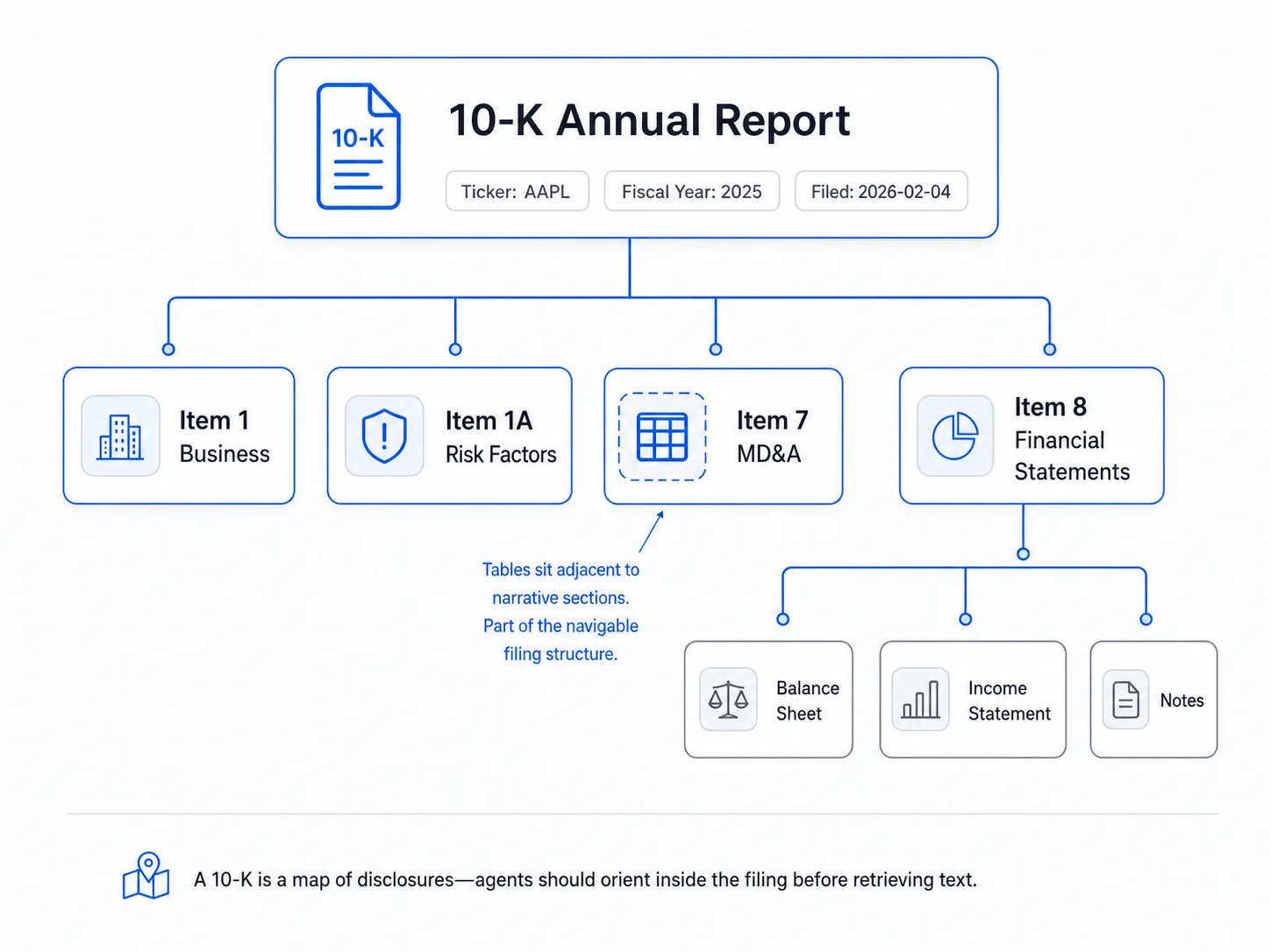
SEC filings are long, structured, repetitive, section-heavy, table-heavy, and legally precise. A 10-K is not just a text blob. It is a map of disclosures: Business, Risk Factors, MD&A, Financial Statements, Notes, Controls, Legal Proceedings, Exhibits, and nested sections inside those categories.
A 10-K has meaningful structure:
- Item 1 - Business explains what the company does.
- Item 1A - Risk Factors describes material risks.
- Item 7 - Management's Discussion and Analysis explains operating results, liquidity, margins, and management's interpretation of the period.
- Item 8 - Financial Statements and Supplementary Data contains audited financial statements and notes.
- Tables often carry the exact values that narrative paragraphs summarize.
- Footnotes may define accounting treatment, segment changes, or comparability issues.
- Similar language can repeat across years with small but important changes.
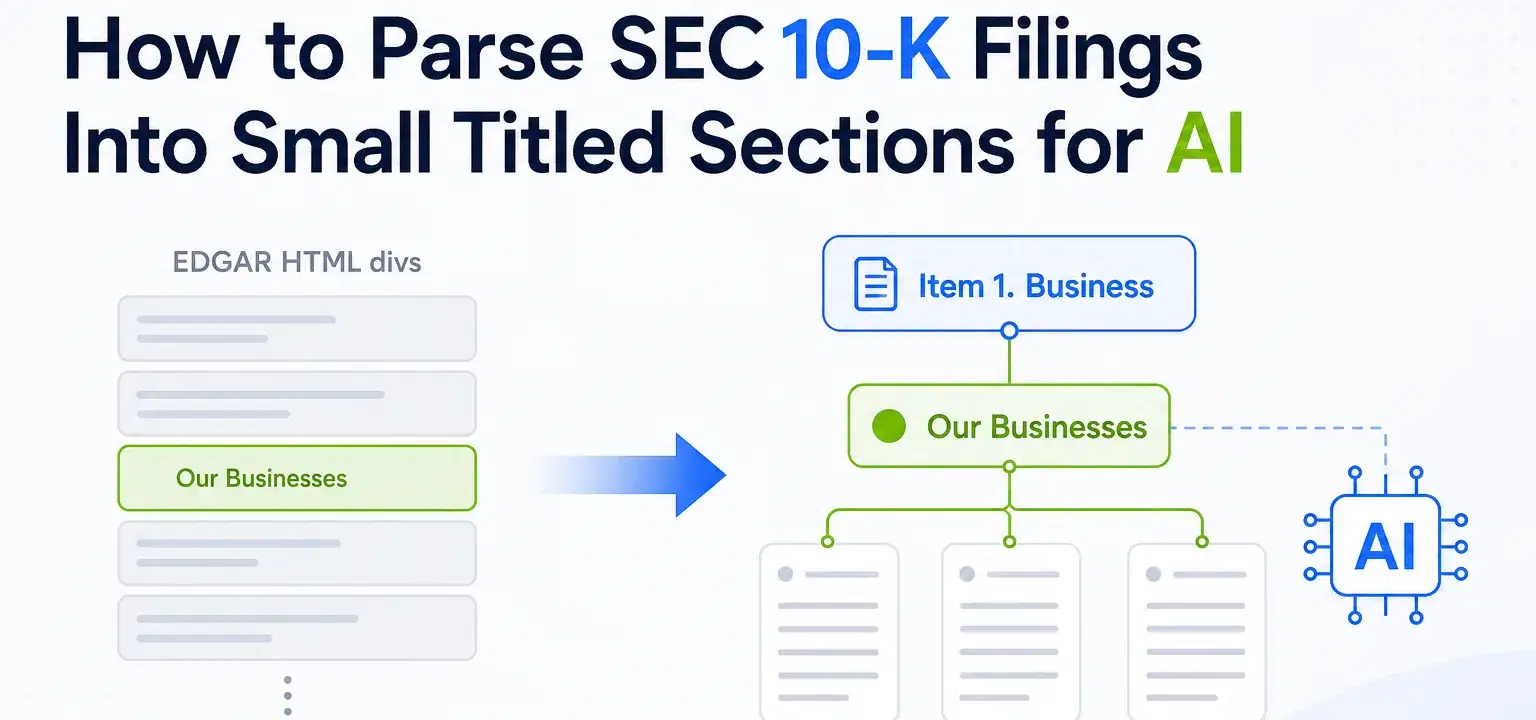
Those major SEC Items are only the first layer. Inside Item 1, Item 1A, Item 7, and Item 8, companies use smaller issuer-specific headings such as business segments, revenue categories, liquidity sub-sections, accounting-policy notes, and individual risk themes. Those small titled sections are the units an agent should usually read. Item 1A may orient the agent to "Risk Factors," but the useful answer may only need the sub-section about supply concentration, export controls, cybersecurity, or customer demand.
When an agent flattens that structure into arbitrary 800-token or 1,500-token chunks, it loses the source context that makes the filing useful. The agent can retrieve a sentence that looks relevant while missing the section heading, nearby table, period, or surrounding disclosure that changes the answer. For the broader architecture comparison, see naive RAG vs structured RAG vs navigation-based agents.
A 10-K is a map of disclosures. Agents should orient inside the filing before retrieving text.
Why do fixed-size chunks fail on 10-Ks and 10-Qs?
Fixed-size chunking is attractive because it is simple: pick a token size, add overlap, embed every chunk, and retrieve the top matches. That simplicity becomes a liability when an SEC filing agent needs the filing's logical structure.
The two most expensive failures are period mixing and table splitting. Risk factors, MD&A language, and segment descriptions often repeat across years, so a semantically similar passage from the wrong filing can look correct unless retrieval is strict about accession number, filing type, filing date, company, and section. Many financial answers also require nearby tables; if the chunk contains the narrative but not the values, the agent may summarize the right topic from incomplete evidence.
For a deeper look at why fixed-size RAG chunks fail on SEC filings at the HTML and section-title level, see how to parse SEC 10-K and 10-Q filings into sections. The key point for this article is that a serious SEC filing agent should treat chunks as supporting units, not as the primary source map. The source map should expose the filing's smaller titled nodes, so the agent can read a bounded section with its title, paragraphs, tables, and citation rather than reading all of Item 1A or Item 7 by default.
What should replace naive RAG for SEC filings?
The alternative is not "no RAG." Retrieval still matters. The better architecture is navigation-first SEC filing retrieval.
Instead of treating SEC filings as flat text blobs, parse them into a navigable structure that goes below top-level SEC Items. Give the agent tools to:
- Select the correct company and filing.
- Inspect the filing table of contents.
- Choose the relevant Item, sub-section, note, table, or titled node.
- Read targeted content without pulling in unrelated sections.
- Prefer source tables when exact values matter.
- Return citations tied to retrieved passages.
This is closer to how a real analyst works. An analyst does not start by embedding the whole filing in their brain. They open the filing, check the filing type and period, look at the table of contents, jump to Item 1A or Item 7, then zoom into the specific risk, MD&A topic, note, or table that answers the question.
Your agent should do the same.
How should an SEC filing agent answer a question?
Here is the workflow I would use for almost every serious SEC filing agent.
1. Map the question to likely filing areas
Different questions require different filing sections.
| User question | Likely target |
|---|---|
| "What are the biggest risks?" | Item 1A, then the specific risk-factor sub-sections |
| "Why did margins change?" | MD&A operating-results nodes and related cost/revenue tables |
| "What changed in revenue mix?" | Segment revenue table nodes, revenue disaggregation notes, and adjacent MD&A text |
| "What are the liquidity concerns?" | Liquidity and capital resources sub-sections |
| "What did management say changed from last year?" | Matching titled nodes across current and prior filings |
| "What are the accounting assumptions?" | Specific notes to financial statements, not all of Item 8 |
A good agent should map intent before retrieval. If it searches first, it can find plausible text in the wrong section or period.
2. Select the filing before reading anything
The agent should choose the filing period explicitly.
Bad workflow:
Search all Apple filings for "gross margin pressure."
Better workflow:
Find Apple's latest 10-Q. Use its artifact or document ID. Inspect its table of contents. Read the relevant MD&A sub-section and the specific financial statement note nodes that support the answer.
For period comparison, select multiple filings intentionally:
Find the latest two 10-K filings for NVIDIA. Inspect Item 1A in both, then read the smaller risk-factor nodes that changed or match the user's topic.
This avoids one of the biggest mistakes in financial RAG: mixing old and new disclosures.
3. Inspect the table of contents
The table of contents gives the agent a filing map. In AlphaCreek, this map is not limited to Part I, Item 1A, and Item 7. The filing is broken into smaller titled nodes with deterministic IDs, so the agent can move from a major Item to the exact sub-section, table, or note it needs.
For a question like "What changed in NVIDIA's risk factors in the latest 10-K?", the agent should not blindly search the entire document. It should find the latest 10-K, inspect the table of contents, identify Item 1A - Risk Factors, then read the relevant smaller risk-factor nodes rather than sending the entire risk-factor section to the model.
That sounds obvious, but many RAG systems do not do it. They search first and ask structural questions later, if at all.
What AlphaCreek's filing table of contents looks like
When an agent calls get_filing_toc, it does not get a flat list of SEC Items only. AlphaCreek returns a hierarchical navigation tree built from the parsed filing: major PART/ITEM boundaries, issuer sub-headings, tables, and approximate token sizes per node.
Here is an excerpt from NVIDIA's FY2026 10-K (EDGAR source, NVDA_10-K_000104581026000021) — the same filing walked through in how to parse SEC 10-K filings into sections:
FILING: NVDA 10-K 2026-01-25 | artifact_document_id=NVDA_10-K_000104581026000021

1 | TopSectionTitle | Part I
1.1 | TopSectionTitle | Item 1. Business
1.1.1 | TitleElement | Our Company (~4142 tokens approx)
    Our Businesses (~103 tokens approx)
        We report our business results in two segments.
        The Compute & Networking segment includes Data Center accelerated computing...
        The Graphics segment includes GeForce GPUs for gaming and PCs...
    Our Markets (~101 tokens approx)
    Data Center (~1064 tokens approx)
    Gaming (~373 tokens approx)
    Automotive (~183 tokens approx)
1.1.8 | TitleElement | Business Strategies (~3957 tokens approx)
    Sales and Marketing (~626 tokens approx)
    Manufacturing (~503 tokens approx)
    Competition (~816 tokens approx)
...
1.2 | TopSectionTitle | Item 1A. Risk Factors (~122 tokens approx)
1.2.2 | TitleElement | Risk Factors Summary (~2438 tokens approx)
    Risks Related to Our Industry and Markets (~56 tokens approx)
    Failure to meet the evolving needs of our markets... (~1000 tokens approx)
1.2.12 | TitleElement | Long manufacturing lead times and mismatches between supply and demand. (~4827 tokens approx)
    Dependency on third-party suppliers... (~794 tokens approx)
1.2.16 | TitleElement | Adverse economic conditions may harm our business. (~4524 tokens approx)
...
2.3 | TopSectionTitle | Item 7. Management's Discussion and Analysis of Financial Condition and Results of Operations
2.3.2 | TitleElement | Overview (~4664 tokens approx)
    Revenue by Reportable Segments (~53 tokens approx)
        Table with ~3 rows, ~14 numbers, and 180 characters.
    Liquidity and Capital Resources (~261 tokens approx)
Each line follows the pattern node_id | element_type | title (~tokens approx), with indented children previewing nested content before a full read.
| Property | What it gives the agent |
|---|---|
Deterministic node IDs (1.1.1, 1.2.12) | Stable handles for read_node_content |
| Element types | TopSectionTitle for SEC Items; TitleElement for issuer sub-headings |
| Token sizes | Helps choose appropriately sized reads instead of whole Items |
| Nested preview | Shows what lives under each title before loading full text |
For a question like "What segments does NVIDIA report?", an agent inspects this tree, spots Our Businesses nested under 1.1.1, and reads that node — not all of Item 1. For a risk-factor comparison, it navigates under 1.2 and selects specific risk nodes such as 1.2.12 instead of embedding the entire Item 1A block.
Verify in the reader (NVIDIA FY2026 10-K, filed January 29, 2026):
| Node | Section | Reader link |
|---|---|---|
1.1.2.1 | Our Businesses — segment disclosure | Open passage |
1.2.12 | Long manufacturing lead times and supply/demand mismatches | Open passage |
1.2.16 | Adverse economic conditions | Open passage |
Each link opens the exact titled node in AlphaCreek's SEC reader. The TOC uses short node IDs (1.2.12); citation URLs use the sp- prefix (sp-1.2.12) returned by read_node_content.
This is the runtime view of the section tree described in the parsing article: flat EDGAR HTML becomes an addressable filing map the agent can navigate before it reads.
4. Read targeted nodes, not the whole filing
Once the agent knows where to look, it should retrieve the relevant nodes. A node can be much smaller than a top-level SEC Item: a titled risk factor, a liquidity paragraph group, a segment table, or an accounting-policy note.
This is where token savings come from. The agent does not need to send the entire 10-K to the LLM. It needs the sections that matter for the question:
- For risk analysis, start in Item 1A, then read the specific risk-factor nodes.
- For revenue by segment, read the segment revenue table node and adjacent notes.
- For margin drivers, read the relevant MD&A operating-results sub-section and cost or revenue discussion.
- For liquidity, read the "Liquidity and Capital Resources" sub-section, not all of MD&A.
- For controls, read the relevant Item 9A control-disclosure node.
The goal is not to minimize context at all costs. The goal is to send the right context.
5. Cite every material claim
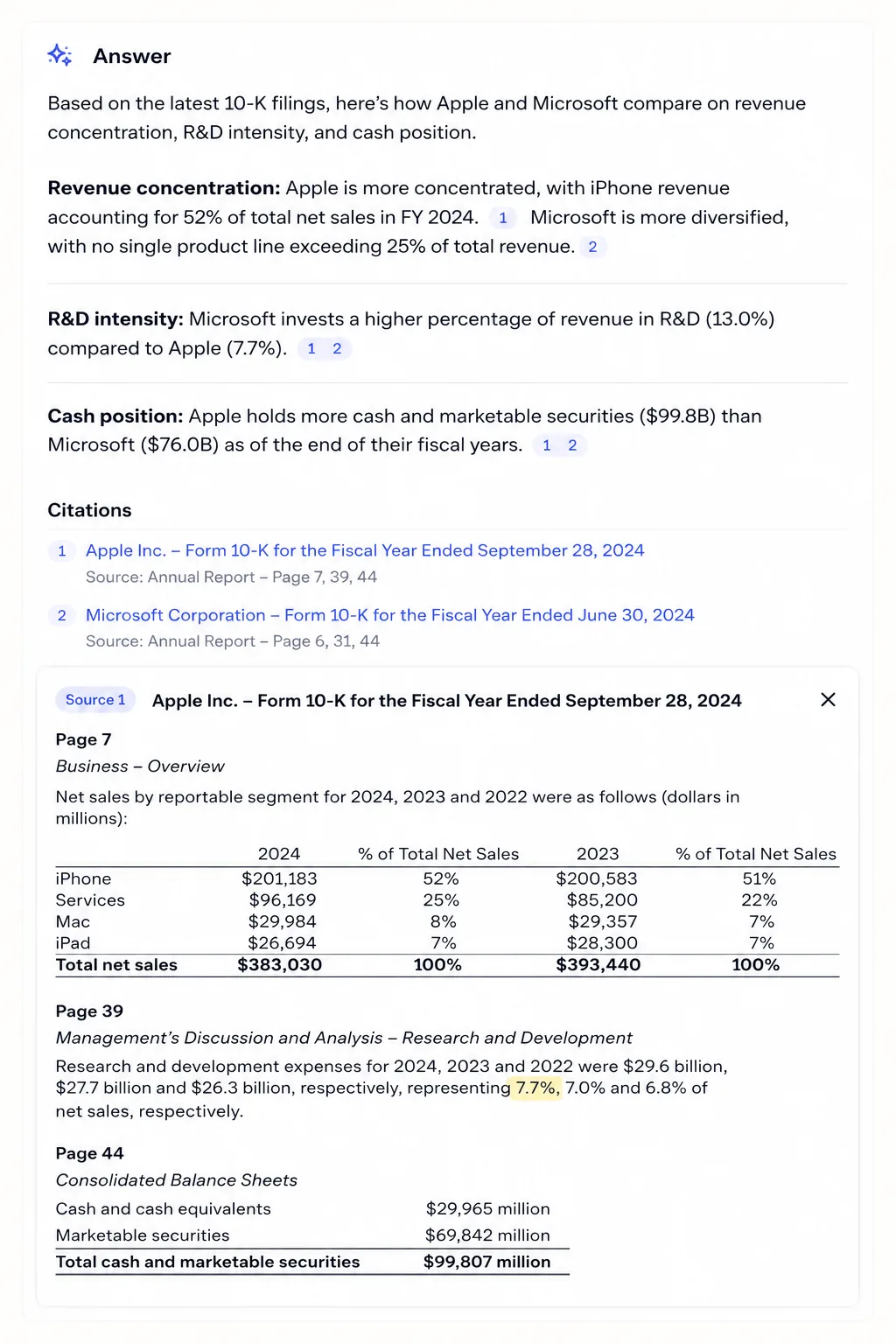
The final answer should not just include a "Sources" section at the bottom. For financial analysis, citations should sit next to the claims they support.
Bad:
The company faces supply chain risks, regulatory pressure, and demand uncertainty. Sources: 10-K.
Better (from NVIDIA's FY2026 10-K, with inline reader links):
NVIDIA reports its business in two segments: Compute & Networking and Graphics. NVDA 10-K, Item 1 › Our Businesses
It also flags long manufacturing lead times and supply/demand mismatches as a material risk. NVDA 10-K, Item 1A › manufacturing lead times
This lets the user verify each claim quickly.
Financial answers should tie each claim to a verifiable source inside the filing, not a generic "Sources: 10-K" footer.
What does SEC filing analysis with AI look like with MCP?
The Model Context Protocol is a good fit for SEC filing retrieval because the retrieval system can expose filing-aware tools that an SEC filing agent calls when needed.
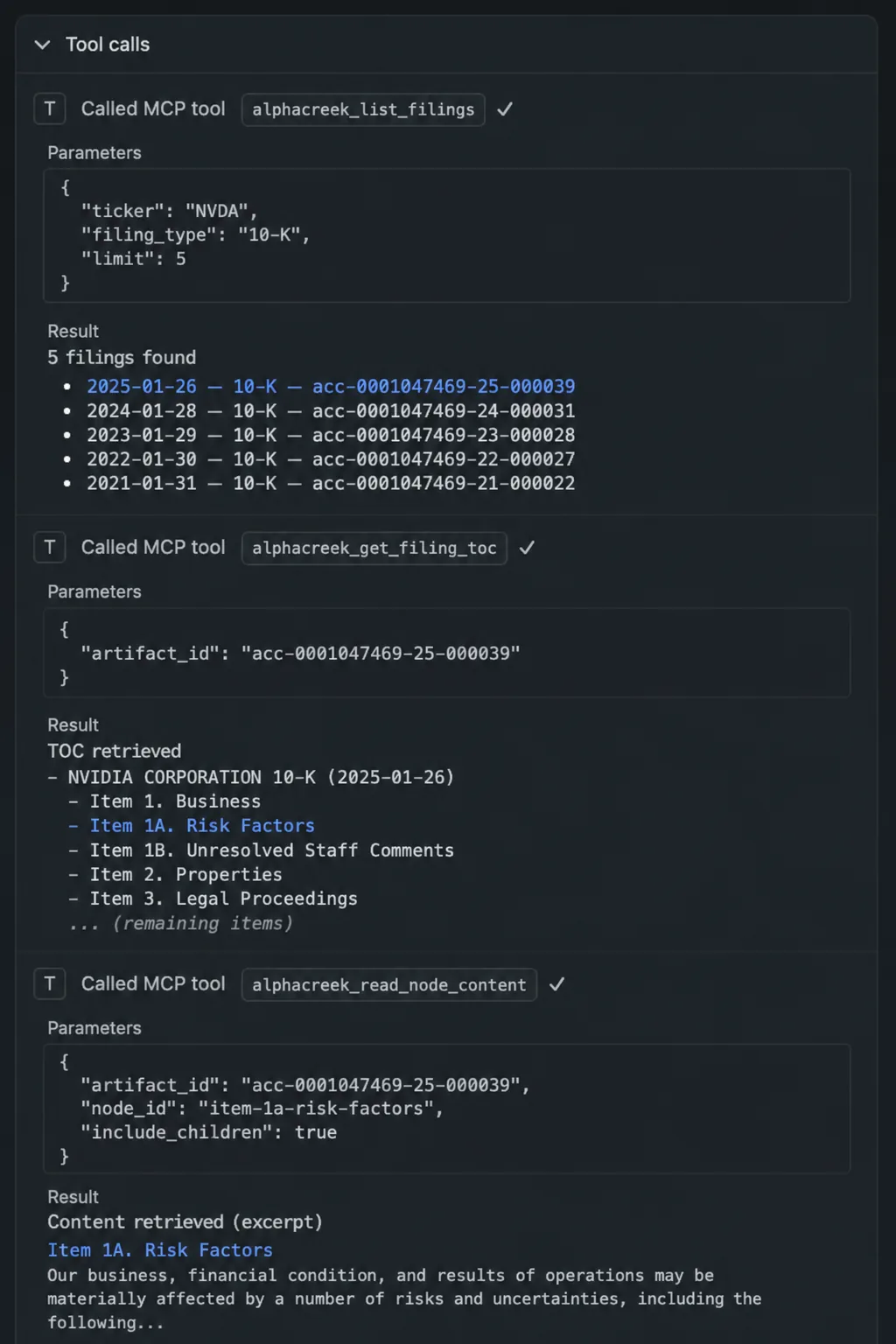
A minimal SEC filing MCP should support tools like:
list_filings- find available filings for a company and filing type.get_latest_filing- get the newest matching filing.get_filing_toc- inspect the filing structure down to smaller titled nodes.read_node_content- read selected filing nodes and return source-linked content.
The important part is not just exposing search. The important part is exposing a workflow:
User question
  -> select company and filing type
  -> list filings or get latest filing
  -> choose the right filing period
  -> inspect the filing table of contents
  -> identify the relevant Item, sub-section, note, or table nodes
  -> read only the targeted nodes
  -> answer with citations next to each material claim
This design forces the agent to reason about filing identity and structure before it answers. It also keeps context focused: the agent can read a handful of small, titled nodes instead of dumping an entire 30-page Item into the prompt.
See the MCP developer docs for tool reference and example traces, or connect AlphaCreek in Claude or ChatGPT to try the workflow. When you are ready to choose a hosted MCP, see best SEC EDGAR MCP servers for AI agents and the July 2026 SEC EDGAR MCP benchmark for citation behavior evidence.
The agent selects the filing and inspects the fine-grained table of contents before reading targeted nodes.
Example: how should an SEC filing agent compare NVIDIA risk factors?
Consider this user question:
What changed in NVIDIA's risk factors in the latest 10-K compared with the previous 10-K?
A naive RAG pipeline might search across all NVIDIA filings for chunks similar to "risk factors changed latest 10-K previous." It may retrieve useful passages, but it may also mix years, miss the full section, or compare incomplete context.
An SEC filing agent should do something more deliberate.
1. List annual filings
{
  "tool": "list_filings",
  "arguments": {
    "ticker": "NVDA",
    "document_type": "10-K",
    "limit": 2
  }
}
The agent now has the latest and previous annual filings with stable document identities.
2. Inspect the table of contents for each filing
{
  "tool": "get_filing_toc",
  "arguments": {
    "artifact_document_id": "NVDA_10-K_000104581026000021"
  }
}
The agent looks for Item 1A - Risk Factors in each filing, then chooses the smaller titled risk-factor nodes needed for the comparison — for example 1.2.12 (long manufacturing lead times) and 1.2.16 (adverse economic conditions).
3. Read the relevant nodes from both filings
{
  "tool": "read_node_content",
  "arguments": {
    "artifact_document_id": "NVDA_10-K_000104581026000021",
    "node_ids": ["1.2.12", "1.2.16"]
  }
}
The retrieval payload should include source text and citation URLs for each selected node. For example, read_node_content on node 1.2.12 returns:
NODE_ID: 1.2.12
TITLE: Long manufacturing lead times and mismatches between supply and demand.
CITATION_URL: https://www.alphacreek.ai/sec/reader?doc_id=NVDA_10-K_000104581026000021&node_id=sp-1.2.12
CONTENT_START
Long manufacturing lead times and uncertain supply and capacity availability...
CONTENT_END
Readers can open that citation URL to inspect the source passage. Node IDs are filing-specific; the important point is that the agent reads addressable sub-sections, not a whole Item by default.
4. Compare the disclosures with citations
Now the model has the right material: matching risk-factor nodes across two specific annual filings. The answer can compare themes, additions, removals, and changes in emphasis with citations attached to supporting passages — for example, linking manufacturing-lead-time language to node 1.2.12 and economic-condition language to node 1.2.16.
That is a better workflow than "retrieve the top 10 similar chunks" because it controls filing identity, section identity, and source attribution before generation.
Why does navigation-first retrieval improve SEC filing agent answers?
Navigation-first retrieval improves financial AI systems in five practical ways.
Better section targeting
The agent can intentionally read Risk Factors, MD&A, Notes, Segment Results, Controls, or Legal Proceedings, then narrow to the specific titled node inside that area instead of hoping similarity search finds the right material.
Better period control
The agent can select the exact filing before reading content. This reduces the risk of mixing old and new disclosures, especially when companies repeat similar language across years.
Better context preservation
Logical nodes preserve section context better than arbitrary chunks. The retrieved unit maps to how the filing is actually organized, which helps the model understand whether a passage belongs to risk factors, management commentary, audited statements, or notes. Because those nodes are smaller than top-level Items, they also reduce irrelevant context without severing titles from the text they describe.
Better citation quality
If each returned node includes a stable citation URL, the final answer can link claims back to the exact passage used. The model should receive citation URLs as part of the retrieved context instead of inventing sources after the fact.
Lower token waste
The agent reads targeted titled nodes instead of sending entire filings, whole Items, or large batches of weakly relevant chunks. This reduces noise while preserving the context that matters.
The point is not that vector search is useless. The point is that vector search alone is not enough. For SEC filings, retrieval should be guided by filing structure.
Where does AlphaCreek fit?
AlphaCreek is built around this filing-aware retrieval model for SEC filing agents.
Instead of asking teams to build their own EDGAR ingestion, filing parser, chunking pipeline, metadata store, citation mapper, and MCP server, AlphaCreek provides a hosted MCP connection to SEC filings that are already ingested, structured, and ready for agent use.
The core idea is simple:
Agents should navigate filings before they read filings.
AlphaCreek exposes that through a navigation-first workflow:
- Find the right filing.
- Load its fine-grained table of contents.
- Read selected filing nodes below the Item level.
- Return content with citation URLs.
- Let the model answer with verifiable source links.
This is why AlphaCreek is different from a generic vector database over SEC filings. The product is not just "search over documents." It is SEC filing retrieval infrastructure designed for agents.
Under the hood, AlphaCreek annotates filings with deterministic hierarchical node IDs such as 1.1.1 and 1.2.12 and serializes a navigation tree from the parsed filing. The table of contents can show major Items, issuer sub-headings, tables, notes, and merged title-plus-content sections with approximate token sizes. That lets an agent choose a small, coherent node to read while still preserving the path back to the filing and citation source.
AlphaCreek sits between your agent and SEC filings as hosted retrieval infrastructure, not a generic vector dump.
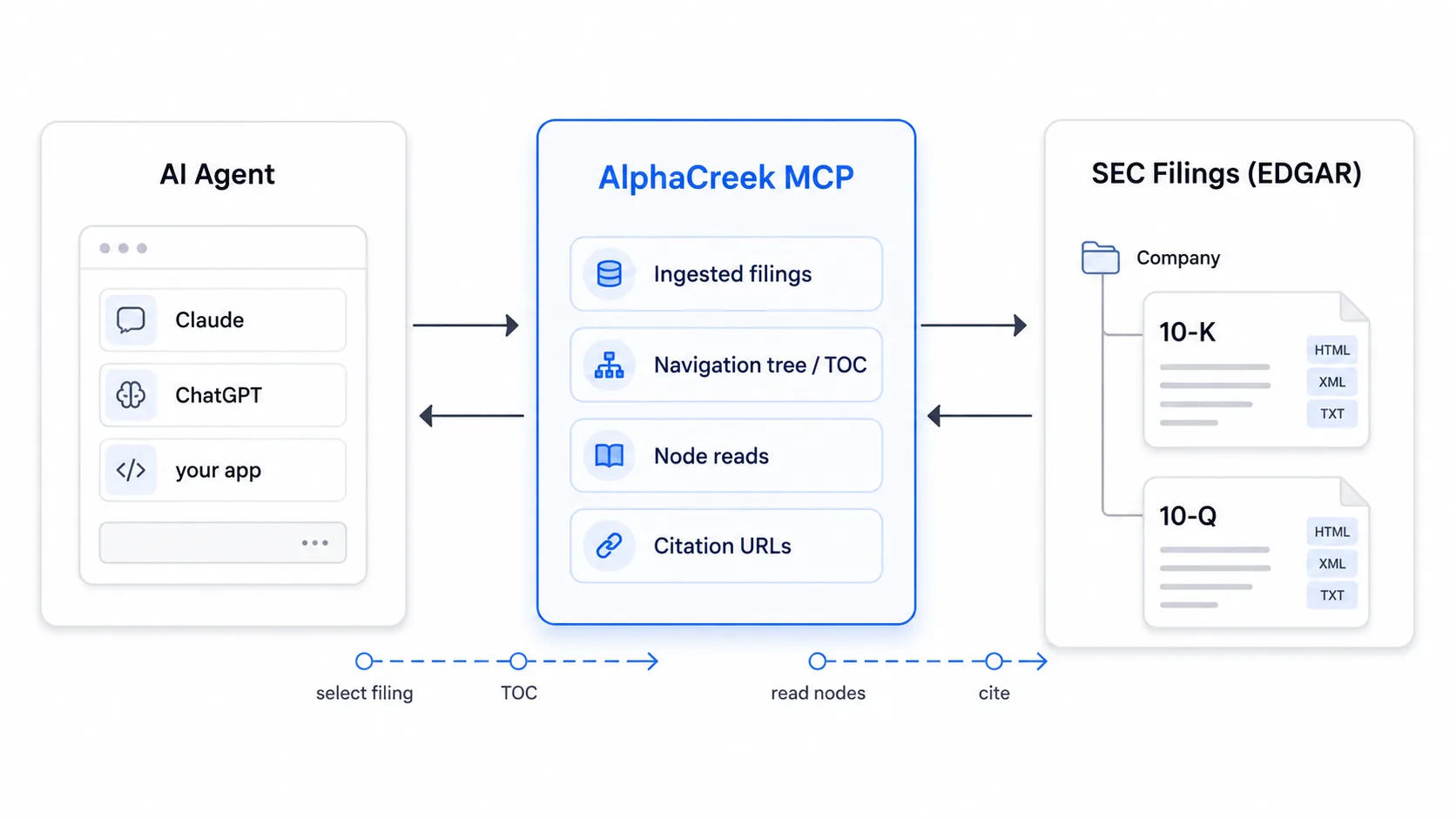
That matters if you are building:
- a filing Q&A product,
- a financial research copilot,
- a due diligence agent,
- an internal analyst assistant,
- a stock research workflow in Claude or ChatGPT,
- or a fintech product that needs source-backed SEC context.
You can build this yourself with the official SEC EDGAR API for XBRL facts, plus open-source tools, your own HTML parser, your own vector store, and your own citation mapping. But if your goal is to ship a financial AI product, the expensive part is not the first prototype. The expensive part is making retrieval reliable enough that users trust the answer.
What architecture should you use in production?
If you are building SEC filing retrieval yourself, I would structure the system like this.
1. Filing ingestion layer
This layer fetches SEC filings and stores metadata:
- ticker,
- company,
- filing type,
- filing date,
- document date,
- accession number,
- source URL,
- internal document ID.
This layer needs retries, update logic, caching, and monitoring. SEC filings are not one-time documents. New filings arrive continuously.
2. Filing parser
The parser should preserve logical structure:
- filing header,
- top-level items,
- nested subsections,
- tables,
- notes,
- linked exhibits where needed.
This is where generic document parsing often fails. Financial filings have messy HTML, inconsistent headings, embedded tables, and company-specific formatting. For a detailed parser walkthrough, see how to parse SEC 10-K and 10-Q filings into sections.
3. Navigation tree
Turn the filing into a tree or table of contents that the agent can inspect.
This is the key abstraction. The agent should be able to ask, "What sections exist in this filing?" before asking, "What text should I read?"
Do not stop at "Item 1A - Risk Factors" or "Item 7 - MD&A." A useful navigation tree should also expose smaller titled sections, tables, and notes inside those Items. In AlphaCreek's navigation tree, each node receives a dotted hierarchical ID (1, 1.1, 1.1.1), and title nodes can carry their direct body content in the TOC so the agent sees both the heading and a compact summary of what it can read.
4. Retrieval layer
Retrieval should support multiple modes:
- direct node reads,
- section targeting,
- metadata filtering,
- keyword search,
- semantic search,
- table-aware retrieval,
- period-aware comparison.
The retrieval layer should not blindly return chunks or entire SEC Items. It should return context with identity: which filing, which Item, which titled sub-section or table node, which node ID, and which source URL.
5. Citation layer
Every retrieved unit should have a stable citation. The model should not invent citations. It should receive citation URLs as part of the retrieved context and place them next to supported claims.
6. Agent instructions
Your SEC filing agent needs strong instructions. Use a prompt like this as a starter:
Starter SEC filing agent instructions
For company financial questions, use SEC filing tools when the answer depends on filings, segment revenue, margins, risks, guidance, MD&A, accounting notes, or reported disclosures.

Choose the filing period first. Inspect the filing table of contents before reading content. Use major Items to orient, then prefer smaller titled node reads over whole-document or whole-Item retrieval. Cite every material claim using the citation URL returned with the supporting passage.

If the retrieved content does not support the answer, say what is missing instead of inferring from model memory.
Without this, even a good retrieval layer may be underused by the model.
What mistakes should SEC filing agents avoid?
Treating the latest filing as always correct
Sometimes the user needs the latest 10-Q. Sometimes they need the latest 10-K. Sometimes they need the prior annual report. Sometimes they need the filing that corresponds to a specific fiscal period. The agent should choose the filing intentionally.
Searching before selecting the document
Searching across all filings first can mix periods and filing types. Select the document set first, then retrieve inside it.
Ignoring tables
For exact values, tables often matter more than narrative. If the filing says "the following table presents...", the agent should inspect the table and nearby explanatory text.
Returning uncited summaries
An uncited financial answer is hard to trust. Even if the model is correct, the user cannot verify it.
Optimizing only for semantic similarity
Similarity is not the same as relevance. In SEC filings, the right answer often depends on filing type, fiscal period, section, and nearby table context.
When is naive RAG still acceptable?
Naive RAG is not always wrong. It can be good enough for:
- quick prototypes,
- internal experiments,
- simple keyword-like questions,
- small document collections,
- cases where citations are not important.
But if users rely on the answer, naive RAG over fixed chunks becomes a liability. The more your users ask comparative, financial, or source-sensitive questions, the more you need structure-aware retrieval.
Questions like these require more than top-k chunks:
- What changed in risk factors over the last two annual reports?
- Why did gross margin change this quarter?
- How did segment revenue mix evolve over the last three filings?
- What does management say about liquidity?
- Which risks are new or more emphasized this year?
- What source supports this specific claim?
Those are the questions financial users actually care about.
FAQ
Can AI analyze SEC filings?
Yes. SEC filing analysis with AI works best when the agent retrieves from the original filing, selects the correct period, reads the relevant section or table, and cites each material claim. A reliable SEC filing agent should use EDGAR source documents rather than relying on model memory or generic summaries.
How is an SEC filing agent different from chat-with-PDF?
Chat-with-PDF tools usually treat a filing as one uploaded document. An SEC filing agent should understand filing type, accession number, fiscal period, table of contents, section identity, tables, and citation URLs. That structure matters when the user asks about 10-K risk factors, MD&A, financial statement notes, or period-over-period changes.
Is this still RAG?
Yes. Navigation-first SEC filing retrieval still uses retrieval. The difference is that retrieval is guided by filing identity, section structure, metadata, tables, and citations instead of only by vector similarity over arbitrary chunks.
Should I avoid vector search entirely?
No. Vector search can be useful for finding relevant language inside a selected filing or section. It should be one retrieval mode inside a filing-aware system, not the only way the agent decides what to read.
Why is the table of contents so important?
The table of contents gives the agent a map of the filing. In a filing-aware system, that map should go deeper than SEC Items and expose smaller titled nodes, tables, and notes. Without that fine-grained map, the agent may retrieve text that sounds relevant but belongs to the wrong section, wrong period, or wrong disclosure context.
Why do citations matter so much for SEC filing answers?
Financial users need to verify claims. Inline citations let the user inspect the exact source passage instead of trusting a generic summary or a document-level citation.
Can I build this without AlphaCreek?
Yes. You can build ingestion, parsing, metadata storage, retrieval, citation mapping, and MCP tooling yourself. AlphaCreek exists for teams that want hosted SEC filing retrieval infrastructure instead of maintaining that pipeline internally.
Methodology and update context
This article is based on AlphaCreek's SEC filing retrieval workflow: selecting filings before reading, using table-of-contents navigation, reading targeted filing nodes, preserving table and section context, and returning citation URLs with retrieved passages.
Primary sources and verified examples
- NVIDIA Corporation Form 10-K for the fiscal year ended January 25, 2026 (CIK 0001045810, accession 0001045810-26-000021) — the filing used for the table-of-contents excerpt, MCP tool examples, and reader links in this article.
- Our Businesses segment disclosure (node
1.1.2.1) — cited in the inline citation example above. - Manufacturing lead times risk factor (node
1.2.12) — cited in the NVIDIA comparison walkthrough. - SEC reporting forms background: Forms List and EDGAR search.
- Parsing background: how to parse SEC 10-K filings into sections — same NVIDIA filing, flat HTML to section tree.
The guidance is opinionated because SEC filings are source-sensitive financial documents. For demo systems, fixed-size chunks may be enough. For products where users make research, diligence, or analysis decisions from the output, the retrieval layer should preserve filing structure and make claims verifiable.
Final takeaway
A financial AI agent should retrieve like an analyst reads.
That means it should identify the company, choose the filing, understand the filing structure, navigate to the relevant section, inspect nearby tables where needed, preserve source context, and cite the answer.
A generic RAG pipeline starts with chunks. A filing-aware agent starts with the filing map, then reads the smallest coherent titled nodes that answer the question. That difference changes the quality of the final answer because SEC filings are not blobs of text, and your agent should not treat them like they are.
If you want to build this infrastructure yourself, the architecture above is the path I would follow. If you want to skip ingestion, parsing, filing maps, citation plumbing, and MCP infrastructure, AlphaCreek gives your AI agent a hosted SEC filing retrieval layer out of the box.
Get started with AlphaCreek
Build filing-aware financial AI without maintaining your own SEC pipeline.
AlphaCreek gives AI agents hosted MCP access to structured SEC filings, navigation trees, targeted node reads, and citation URLs.
Get a free API key · View MCP docs · Connect in Claude or ChatGPT
Related pages