SEC EDGAR MCP Servers (2026): Open Source vs Hosted

Compare sec-edgar-mcp, EdgarTools, edgar.tools, and AlphaCreek. Pick self-hosted or hosted SEC EDGAR MCP by job: XBRL, signals, or cited passages.
SEC EDGAR MCP Servers (2026): Open Source vs Hosted
Table of contents
- Short answer
- What is an SEC EDGAR MCP server?
- Open source vs hosted: the fair comparison
- sec-edgar-mcp (GitHub): best known open-source starter
- EdgarTools MCP: best free Python library + MCP
- edgar.tools hosted: best for broader tools and signals
- AlphaCreek hosted: best for citable, navigable filing context
- Hosted MCP benchmark: AlphaCreek vs edgar.tools vs SEC API
- How should you choose?
- What most SEC EDGAR MCP comparisons get wrong
- Recommended setup by use case
- FAQ
- Methodology and what changed
- Final takeaway
Short answer
An SEC EDGAR MCP is a Model Context Protocol server that lets an AI agent call tools for SEC filing data. It is not one product. Open-source servers and hosted servers both exist.
Use sec-edgar-mcp if you want a well-known GitHub/Docker starter for 10-K, 10-Q, 8-K, XBRL statements, and Form 3/4/5, and you will host it yourself. Use open-source EdgarTools MCP if you want a free MIT Python library plus 13 intent-based MCP tools and you will own SEC rate limits and ops. Use edgar.tools hosted if you want a broader SEC intelligence workstation: monitoring, watchlists, enriched signals, and a larger tool set. Use AlphaCreek hosted if you are building a financial AI product and need citable, navigable filing context: original 10-K / 10-Q / 20-F / 6-K / 8-K language, a filing table of contents, targeted reads, and a CITATION_URL on the exact passage.
Why it matters: searching “sec edgar mcp” currently surfaces GitHub, PyPI, and Docker first. Those are real options. They are self-hosted building blocks. They are not a hosted retrieval backend for a product that must show users the paragraph behind each claim.
Practical takeaway: choose by job, not by tool count. Self-host if you want control and can run EDGAR access. Buy hosted retrieval if you want citations, freshness, and MCP uptime without owning the stack.
| If you need... | Best pick |
|---|---|
| Docker/GitHub starter for filings, XBRL, and insider forms | sec-edgar-mcp (self-hosted) |
| Free MIT Python library + 13 MCP tools, full SEC form breadth | EdgarTools MCP (self-hosted) |
| Broader tools, monitoring, watchlists, enriched signals | edgar.tools hosted |
| Citable, navigable 10-K/10-Q/8-K context inside a product | AlphaCreek hosted |
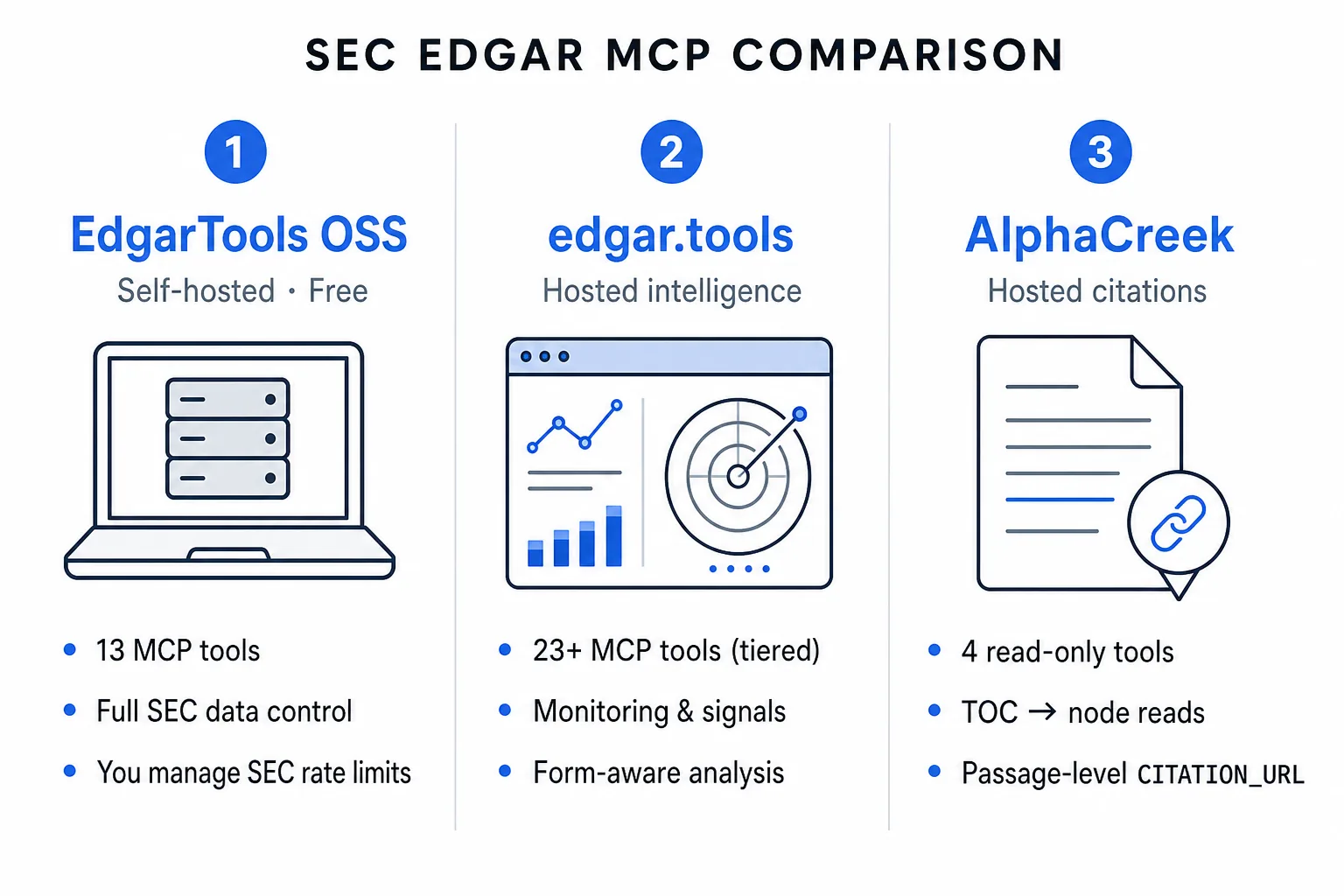
OSS vs hosted is the first split. GitHub sec-edgar-mcp sits with EdgarTools OSS on the self-hosted side. Hosted evidence: SEC EDGAR MCP benchmark.
What is an SEC EDGAR MCP server?
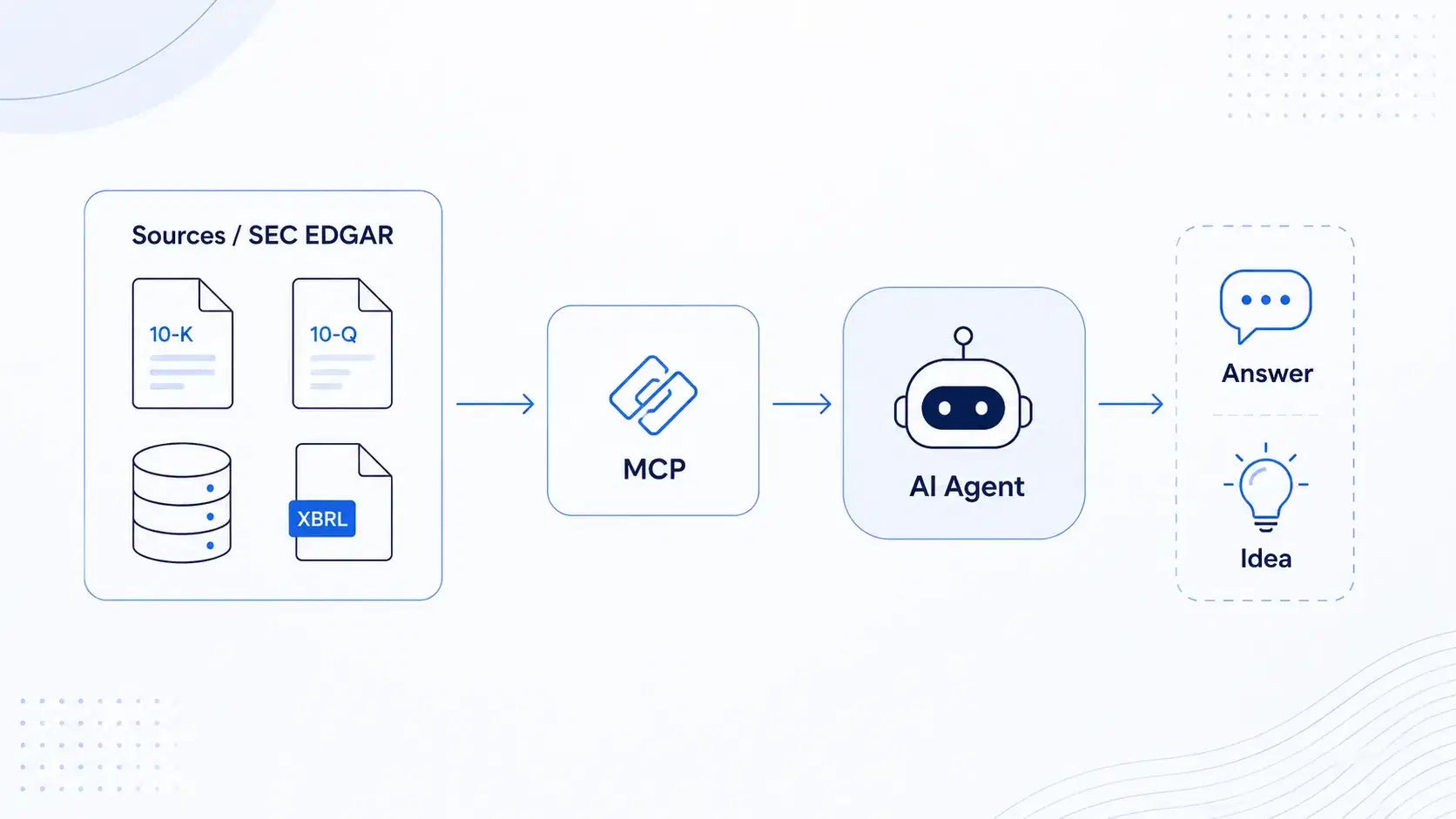
An SEC EDGAR MCP server sits between the model and SEC data. The agent calls tools instead of guessing from training data or browsing EDGAR in a browser.
Typical tools include: look up a company, list filings, read a 10-K or 10-Q section, pull XBRL facts, or return a filing URL. Model Context Protocol is the connector standard used by Claude, Cursor, and other MCP clients.
For financial AI, the filing is source-sensitive. Period, form type, section, table, note, and wording all matter. The buyer question is not “does an MCP exist?” It is: should you self-host a free server, buy a hosted intelligence platform, or buy hosted filing retrieval with passage citations?
AlphaCreek is one hosted option. It is not the only SEC EDGAR MCP. For the architecture behind navigation-first retrieval, see AI agents over SEC filings: RAG vs navigation. For official JSON vs narrative HTML, see SEC EDGAR API vs MCP.
Open source vs hosted: the fair comparison
Open source gives you SEC building blocks. Hosted products give you a retrieval or intelligence backend. Do not treat GitHub stars as a product evaluation.
| Dimension | sec-edgar-mcp | EdgarTools MCP | edgar.tools hosted | AlphaCreek hosted |
|---|---|---|---|---|
| One-line job | Self-hosted EDGAR MCP starter | Free Python SEC library + MCP | Hosted SEC intelligence workstation | Hosted citable filing retrieval |
| Deployment | Docker, pip/uv, or streamable HTTP on your network | Local or self-hosted MCP | Hosted MCP, API, web app | Hosted remote MCP |
| License / lock-in | AGPL-3.0; commercial license from the author | MIT | Commercial SaaS | Commercial SaaS |
| Self-serve price | Free software; you pay infra and SEC ops | Free software; you pay infra and SEC ops | Free $0 → Pro $30/mo → Analyst $109/mo (public MCP page, Aug 2026) | Free $0 → Pro $9.99/mo → Team $79.99/mo (non-commercial self-serve; commercial is Custom) |
| Filings / coverage | 10-K, 10-Q, 8-K, XBRL statements, Form 3/4/5 (README) | Broad: sections, XBRL, Form 4, 13F, funds, proxy, 30+ form types (announcement) | Form-aware analysis, events, ownership, funds, live filings | 10-K, 10-Q, 20-F, 6-K, 8-K filing context only |
| Citations | SEC filing URLs on responses (README) | Real SEC data; citation UX is yours | Filing-level sec.gov index links in our benchmark Q1 | Passage-level CITATION_URL per node |
| Who owns EDGAR rate limits, cache, auth, uptime | You. HTTP mode has no auth; keep it private (README) | You. Set EDGAR_IDENTITY. SEC fair access is 10 req/s | Vendor, within account limits | Vendor, within account limits |
| Main weakness | You operate it; AGPL can pause some commercial teams | Production SEC ops are on you | Broader than a pure retrieval need | Narrower than a full SEC data platform; no Form 4 / 13F / prices |
The important point: more MCP tools do not automatically mean better agent answers. Open source wins on control and form breadth. Hosted wins when you do not want to run EDGAR yourself. AlphaCreek wins only when the product job is cited original language, not when the job is XBRL statements or insider sentiment.
sec-edgar-mcp (GitHub): best known open-source starter
stefanoamorelli/sec-edgar-mcp is the repository people land on first for the query sec edgar mcp. It also appears on PyPI and Docker Hub. That ranking is deserved: the README is clear, Docker is the documented quick start, and the tool list matches a common agent job.
It is built on sec-edgar-toolkit, not on EdgarTools. Do not treat it as a rename of EdgarTools MCP.
What it covers
The README groups tools as:
- Company: CIK lookup, company info, company facts
- Filings: 10-K, 10-Q, 8-K retrieval and section extraction
- Financials: balance sheet, income statement, cash flow (XBRL)
- Insider trading: Form 3/4/5
All responses include SEC filing URLs. That is a real citation story. It is filing-level (or document-level) verification, not a scroll-to-passage reader URL.
Where it is the wrong buy for a SaaS product team
You still host, scale, and monitor it. Streamable HTTP has no authentication and should stay on private networks. The license is AGPL-3.0; some commercial teams need a separate license from the author.
Those are ownership costs, not quality insults. If you want a local Claude or Cursor connection and you accept ops, start here.
Best fit
Choose sec-edgar-mcp if you searched “sec edgar mcp”, want Docker today, and will run the server yourself.
EdgarTools MCP: best free Python library + MCP
Open-source EdgarTools MCP is the best free alternative if you are comfortable hosting the MCP server and you already live in Python. It is part of the EdgarTools ecosystem. The EdgarTools MCP announcement describes a free MIT server with 13 tools for Claude Desktop, Claude Code, and internal apps. No API key. Set EDGAR_IDENTITY and go.
What it covers
The announcement groups tools by analyst intent:
- Discover: company profiles, search, screeners, full-text filing search,
edgar_monitorfor recent filings - Examine / analyze: filing reads (
edgar_read), XBRL trends, company compare, Form 4 and 13F ownership, funds, proxy compensation
That breadth is a real advantage. If you need XBRL, insider activity, 13F holdings, funds, and proxy statements in one free MCP, EdgarTools is hard to ignore.
Where the free option becomes expensive
Free software is not operationally free. SEC fair-access guidance limits automated access to 10 requests per second and requires a declared user agent. A product with many users needs shared caching, retries, 403/429 monitoring, and a queue across all agent traffic.
You also own citation mapping if your UI must open the exact paragraph, not the filing index.
Best fit
Choose EdgarTools MCP if you want MIT, Python objects, and broad SEC coverage, and you will operate EDGAR access.
edgar.tools hosted: best for broader tools and signals
edgar.tools hosted is the commercial platform around the EdgarTools ecosystem. The open-source project gives you local access. The hosted platform adds OAuth, account tiers, API access, hosted MCP, live filing streams, webhooks, precomputed intelligence, and recipe-style workflows.
Public MCP materials (August 2026) describe a tiered tool ladder: Free $0/month, Pro $30/month, Analyst $109/month. Free covers lookups and company briefs. Pro unlocks more of the research toolkit. Analyst adds deeper analysis and aggregation. Confirm live prices on edgar.tools/mcp before you buy.
This is the strongest option if you want a broader SEC intelligence product, not a narrow filing-retrieval layer.
What the hosted platform adds
Public pages describe company briefs, filing analysis, financial snapshots, insider activity, classified 8-K events, live filings, watchlists, and research recipes. edgar.tools is especially strong for “what important 8-Ks came out today?” and “watch this company.”
edgar.tools tells the assistant to cite the source filing. In our July 2026 hosted MCP benchmark, that citation was a sec.gov filing index URL repeated for every NVDA risk claim on question 1 — correct filing, no scroll-to-passage. We ran Professional because the free tier did not expose full 10-K section text via MCP in our tests.
Best fit
Choose edgar.tools hosted if you want monitoring, enriched signals, Form 4 / 13F / events, and a larger hosted tool set.
AlphaCreek hosted: best for citable, navigable filing context
AlphaCreek is not the broadest SEC data platform. It is a hosted retrieval layer for teams that build financial AI products.
The customer-facing job is: turn raw EDGAR filings into citable, navigable context. That saves time. That saves token cost. The agent can back up answers with actual passage citations. Filing maps and node IDs are how the product does that work. They are not the promise.
Coverage is 10-K, 10-Q, 20-F, 6-K, and 8-K. AlphaCreek does not claim Form 4, 13F, or prices.
The public AlphaCreek MCP surface is four read-only tools:
list_filings— filings by ticker, form type, and periodget_latest_filing— newest matching filingget_filing_toc— filing table of contents with node IDsread_node_content— node text plusNODE_IDandCITATION_URL
Connect it in Claude, Cursor, or another MCP client.
Why passage citations are the wedge
Financial users need to verify the answer. If the agent says demand weakened or a segment mix changed, the user should open the paragraph that supports the claim.
read_node_content returns a CITATION_URL. The recommended answer style is to place those links next to material claims. In our hosted MCP benchmark, AlphaCreek was the only hosted provider that linked each NVDA risk claim to a unique reader URL with doc_id and node_id — for example NVIDIA export-controls risk.
Open-source servers also return SEC URLs. That is not the same UX as a passage-level reader link. Do not say open source “cannot cite.”
Freshness vs user-facing alerts
edgar.tools is stronger for watchlists and event alerts. AlphaCreek continuously ingests covered filings so get_latest_filing and the table of contents are already there. Public product materials describe freshness under five minutes for new submissions in the covered form set.
Best fit
Choose AlphaCreek if you are a founder or CTO building a research copilot, diligence workflow, or analyst assistant that must show source-backed filing language. FlexReport uses that citation loop in production. See Build with AlphaCreek MCP and how to build an SEC filing agent without naive RAG.
Do not choose AlphaCreek if you need Form 4 sentiment, 13F holdings, fund data, or a self-hosted stack with no vendor.
Hosted MCP benchmark: AlphaCreek vs edgar.tools vs SEC API
Open-source servers are not in this hosted run. We ran the same agent loop, model (gpt-5.4-mini), and three filing questions against AlphaCreek (Free), edgar.tools (Professional), and SEC API (Free) on July 9, 2026. Full traces: benchmark article · GitHub.
| Question | AlphaCreek | edgar.tools | SEC API |
|---|---|---|---|
| Q1 — NVDA risks (with per-claim citations) | Success | Success | Success |
| Q2 — TSLA strategy (5×10-K) | Success | Success | Failed (session terminated) |
| Q3 — AAPL revenue segments | Success | Success | Failed (HTTP 503) |
Balanced read: Where runs completed, answers and LLM costs (~$0.04–0.10 per question) were comparable. The decision driver was citation granularity and retrieval style, not prose quality alone. AlphaCreek read the filing TOC then targeted sub-nodes. edgar.tools and SEC API typically pulled whole sections. On Q1, only AlphaCreek met “cite each claim” with passage-level URLs. edgar.tools repeated a sec.gov index link. SEC API repeated a sec.gov .txt link. SEC API Q2/Q3 failures are inconclusive.
Where SEC API fits: a broad financial data platform with a large MCP surface. Treat it as hosted data when you will allowlist tools and design citation UX yourself. Our run used the free tier.
How should you choose?
| Your goal | Best fit |
|---|---|
| Docker today, GitHub docs, local Claude/Cursor | sec-edgar-mcp |
| MIT Python library, XBRL, Form 4, 13F, funds, proxy | EdgarTools MCP |
| Build and operate your own SEC stack | Either OSS option |
| Live alerts, watchlists, enriched 8-K / insider signals | edgar.tools hosted |
| Embed cited 10-K/10-Q/8-K retrieval in a product | AlphaCreek hosted |
| Compare MD&A or risk language across periods with passage links | AlphaCreek hosted |
| Avoid direct SEC rate-limit operations | edgar.tools hosted or AlphaCreek hosted |
| Wide hosted financial data MCP; you will allowlist tools | SEC API — see benchmark caveats |
If you are experimenting on a laptop, start with sec-edgar-mcp or EdgarTools MCP. If you want signals and monitoring, use edgar.tools hosted. If you are shipping a product that must open the exact passage, use AlphaCreek hosted.
What most SEC EDGAR MCP comparisons get wrong
- “The” SEC EDGAR MCP. GitHub, EdgarTools, edgar.tools, AlphaCreek, and others all exist. Do not rank them as if only one server is real.
- More tools = better agent. Tool schema is in the model context every turn. Filing Q&A often needs a short, clear path.
- SEC access = filing understanding. Raw EDGAR still leaves parsing, section boundaries, tables, and citation design to you or the vendor.
- Any filing URL = verifiable answers. An index page or
.txtblob is not the same as the sentence or table cell behind the claim. - Open source cannot cite. sec-edgar-mcp includes SEC filing URLs. The gap is passage-level product UX and who operates the server.
- Free OSS has no cost. At scale you pay engineering for caching, fair-access limits, and uptime.
Recommended setup by use case
Local Claude Desktop or Cursor, Docker first — sec-edgar-mcp. Set SEC_EDGAR_USER_AGENT. Keep HTTP mode off the public internet.
Local Python, MIT, broad forms — EdgarTools MCP. Set EDGAR_IDENTITY. Example from their docs: uvx --from edgartools[ai] edgartools-mcp.
Financial ratios, insider activity, live filings, signals — edgar.tools hosted. MCP uses OAuth. Budget for Pro/Analyst if you need full section reads.
Financial AI product with cited filing answers — AlphaCreek hosted MCP. Workflow: list_filings → get_filing_toc → read_node_content → cite CITATION_URL. Start at /connect.
Structured financials plus original filing language — Use EdgarTools, edgar.tools, or official CompanyFacts JSON for XBRL. Use AlphaCreek when the answer must quote and link the disclosure passage. See SEC EDGAR API vs MCP.
Evaluating hosted MCPs with evidence — Reproduce the benchmark before you choose on marketing copy.
FAQ
What is the best SEC EDGAR MCP server?
There is no single best server. sec-edgar-mcp and EdgarTools MCP are best for self-hosted access. edgar.tools hosted is best for broader tools and monitoring. AlphaCreek hosted is best for citable, navigable 10-K/10-Q/8-K context inside a product.
Is sec-edgar-mcp the same as EdgarTools?
No. sec-edgar-mcp is Stefano Amorelli’s AGPL server on sec-edgar-toolkit. EdgarTools MCP is the MIT MCP that ships with the EdgarTools Python library. Both are open-source SEC EDGAR MCP servers. They are different codebases.
Is EdgarTools MCP the same as edgar.tools?
No. Open-source EdgarTools MCP is free and self-hosted. edgar.tools is the hosted commercial platform, with hosted MCP, monitoring, and a web app.
Why does AlphaCreek only have four MCP tools?
The product is one retrieval workflow: find the filing, inspect the table of contents, read targeted nodes, cite the passage URL. A smaller tool surface also keeps tool-schema tokens down.
Which option is best for citation-backed SEC filing answers?
If the user must open the exact passage, AlphaCreek is the strongest hosted fit in our July 2026 benchmark. Open-source servers can return SEC document URLs. edgar.tools and SEC API pointed to filing-level sec.gov resources on our Q1 run.
Can Claude access SEC filings through MCP?
Yes. Use sec-edgar-mcp, EdgarTools MCP, edgar.tools hosted, AlphaCreek hosted, or another SEC MCP. Setup differs: Docker + user agent, EDGAR_IDENTITY, OAuth, or AlphaCreek API key/OAuth.
Are SEC EDGAR MCP servers free?
The two open-source servers in this article are free software (you pay infra). Hosted products have free tiers with quotas. edgar.tools free MCP did not expose full 10-K section text in our benchmark. AlphaCreek self-serve Free/Pro/Team is non-commercial; commercial use is a Custom plan.
Methodology and what changed
This comparison uses the sec-edgar-mcp README (tools, Docker, AGPL, no HTTP auth, filing URLs), the EdgarTools MCP announcement, the edgar.tools MCP page (visited 21 Aug 2026), SEC fair-access guidance, AlphaCreek MCP docs, AlphaCreek pricing, and the 9 Jul 2026 hosted MCP benchmark.
21 Aug 2026 refresh: added sec-edgar-mcp as a first-class option because it is the primary GitHub/PyPI/Docker result for “sec edgar mcp”; split OSS vs hosted as the buyer table; updated edgar.tools public list prices to Free / Pro $30 / Analyst $109; aligned AlphaCreek copy with citable, navigable context (not “the only SEC MCP”). Tool counts and prices change. Re-check vendor pages before you buy.
This article is about technical infrastructure. It is not investment advice.
Final takeaway
The best SEC EDGAR MCP depends on the job.
Self-host sec-edgar-mcp or EdgarTools MCP if you want building blocks and will operate EDGAR. Use edgar.tools hosted for signals and monitoring. Use AlphaCreek hosted when your agent must return original filing language with a passage you can open.
The winning question is not “which MCP has the most tools?” It is “which MCP gives my agent the right source context for the answer I need?”
Connect AlphaCreek MCP · MCP developer docs · SEC EDGAR MCP benchmark · SEC filing agent guide