AlphaCreek Brings Citation-Grade SEC Filing Intelligence to Perplexity

AlphaCreek is an SEC filing retrieval layer for AI agents, and it is now available as a connector inside Perplexity Computer. With one connection, Perplexity users can access filings across 6,000+ US tickers and UK FCA National Storage Mechanism disclosures across 380 Official List issuers, then return answers with links to the specific source passage behind each claim. This post explains what that changes for financial research, what you can ask today, and where AlphaCreek is going next.
Key takeaways
- AlphaCreek is now available for Perplexity workflows that need direct access to SEC and UK FCA filing text rather than second-hand web summaries.
- Every retrieved passage includes a citation URL that points back to the source location used to answer the question.
- US coverage includes 10-K, 10-Q, 8-K, 20-F, and 6-K filings across 6,000+ tickers, with ingestion in under 5 minutes after a filing reaches EDGAR.
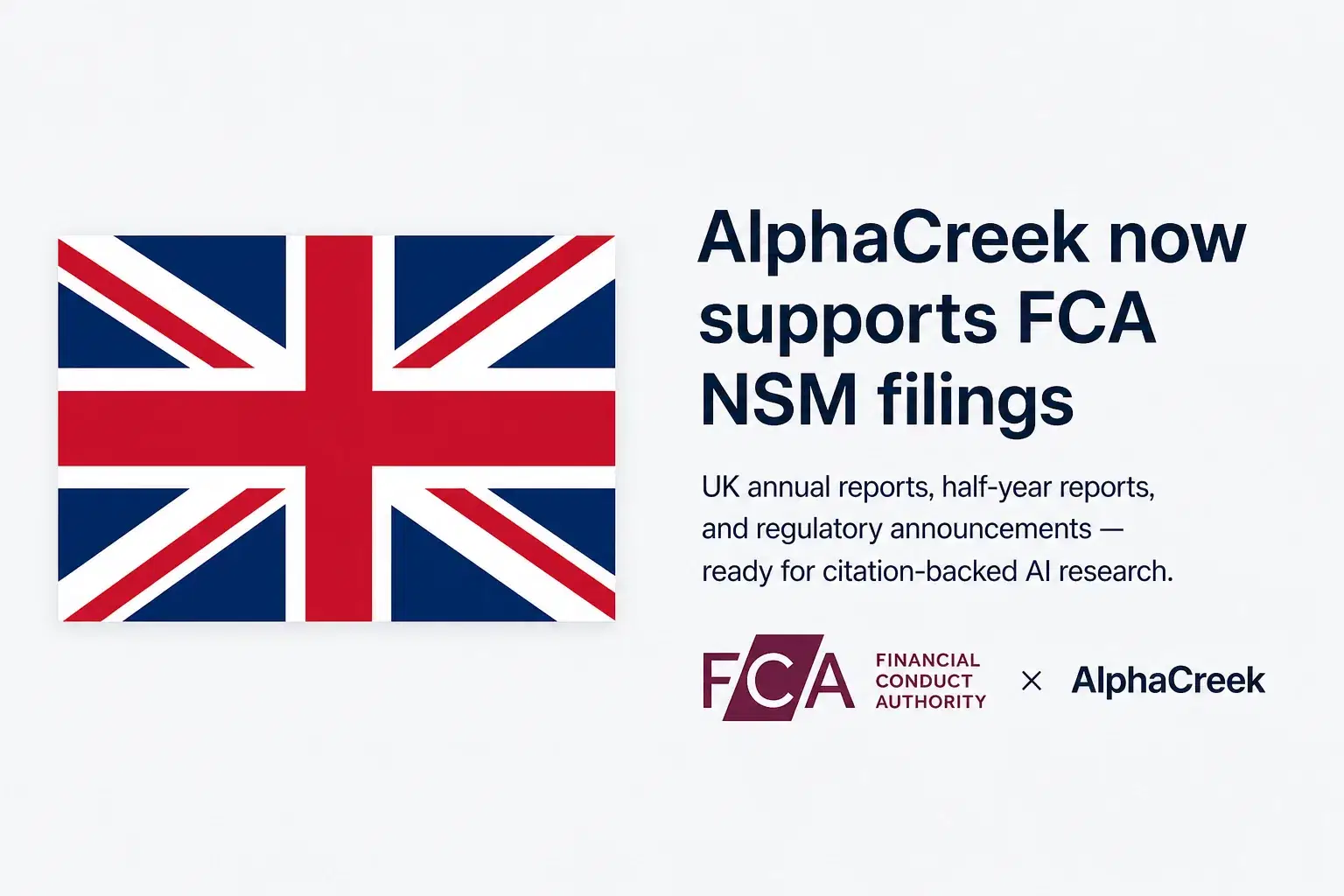
- UK coverage went live on August 18, 2026, with 4,000+ FCA NSM documents across 380 Official List equity commercial issuers.
- AlphaCreek uses filing navigation and targeted retrieval rather than treating a 200-page filing as one large document, reducing token consumption by up to 85% in applicable workflows.
Table of contents
- What does the AlphaCreek connector do inside Perplexity?
- Why does a citation layer matter inside an answer engine?
- What can you actually ask on day one?
- How is this different from Perplexity searching EDGAR on its own?
- What coverage do you get today?
- What is coming next?
- How do you connect AlphaCreek in Perplexity?
- Frequently asked questions
What does the AlphaCreek connector do inside Perplexity?
The AlphaCreek connector gives Perplexity a direct line into the actual text of SEC and FCA filings, so questions about a company's disclosures can be answered from the filing itself rather than from whatever article happens to surface on the open web.
Perplexity is already built for web research and synthesis. Filings present a different retrieval problem. A 10-K can run hundreds of pages, contain dense tables and footnotes, and use legally precise language where a loose paraphrase can change the meaning. With Perplexity Computer, AlphaCreek subscribers can turn those insights into action, preparing reports, dashboards, presentations, and more.
AlphaCreek prepares those filings for agentic retrieval before Perplexity needs them. Each filing is parsed into a navigation map, allowing an agent to identify the relevant Item, subsection, note, or table before pulling the underlying text.
The workflow looks like this:
Ask a question → navigate the filing structure → retrieve the relevant passage → answer with a source link
This is the same navigation over naive RAG approach we use across AlphaCreek.
The result is less irrelevant context and more precise source material. In applicable workflows, AlphaCreek can reduce token consumption by up to 85% compared with sending raw filing text into a model.
One connection also spans two regulatory archives: US SEC EDGAR and the UK's FCA National Storage Mechanism.
Why does a citation layer matter inside an answer engine?
An answer engine is only as useful as the sources behind its answers, and financial research requires the ability to verify those sources directly.
An analyst can use a model to summarize a filing, but the summary is not the final product. The analyst still needs to know which filing, which period, which section, and which exact language supports the conclusion.
That becomes especially important when a model encounters similar disclosures across multiple years. Without filing-aware retrieval, an answer can accidentally summarize the wrong period, paraphrase a covenant too loosely, or blend a company's disclosure with commentary from another source.
A citation should therefore be part of the retrieval process, not something added after the answer has already been generated.
AlphaCreek returns the source URL alongside the retrieved passage. That means the final answer can link a claim directly to the filing location used to support it.
This is the same citation workflow FlexReport runs in production, and it is also why we have benchmarked AlphaCreek against other SEC MCP providers.
A simple example illustrates the difference.
Suppose an analyst asks why NVIDIA's China Data Center business changed during a given reporting period. A market data feed might surface the revenue number. A filing-aware retrieval layer can go further and retrieve management's own disclosure explaining what happened, then link directly to the relevant passage.
That distinction matters when the question is not simply "what was the number?" but "what did the company actually say?"
What can you actually ask on day one?
You can use AlphaCreek for questions that depend on the language, structure, and historical disclosures in a filing rather than just a number from a financial data feed.
Earnings post-mortem
The earnings number is already known. The useful question is why it changed.
"Pull [TICKER]'s most recent 10-Q and walk me through every margin driver management names, with a source link on each one."
AlphaCreek can retrieve the relevant MD&A and supporting disclosures rather than forcing the model to work through an entire filing.
Risk factor diffing
Risk Factors are particularly useful for comparing what changed between periods and across companies.
"Compare the Risk Factors sections of the latest 10-Ks for [TICKER A], [TICKER B], and [TICKER C]. What risk did one add that the others have not?"
This type of question is difficult to answer reliably when filings are treated as flat documents because the model needs to find the corresponding section in each filing first.
Covenant and credit language
Private credit, BDC, lending, and credit research teams often care about exact contractual language.
"Find the borrowing base mechanics and covenant package in [TICKER]'s latest secured facility disclosure. Quote the exact language."
For questions like this, the source passage matters as much as the summary.
Customer and revenue concentration
Customer concentration disclosures can reveal changes that do not appear in a standard financial data feed.
"What does [TICKER]'s latest annual filing disclose about customer concentration, and how has that changed over the last three years?"
The agent can work across multiple annual filings while keeping each answer tied to its underlying disclosure.
Cross-border filing research
Financial research increasingly crosses regulatory regimes.
"Fetch filings from the FCA. Compare Tesco's last three annual reports. How did the strategy and management goals change?"
The FCA's National Storage Mechanism is the UK's official mechanism for storing regulated information and allows users to search disclosures and documents. (FCA)
Perplexity Computer also makes these workflows more interesting than a standalone chat query. Because Computer can work across connected sources, filing research can be combined with other connected business data in the same task.
| Role | Question | Typical data feed | AlphaCreek |
|---|---|---|---|
| Equity analyst | Why did margins change? | Financial metrics | Management's explanation with source passage |
| Credit analyst | What are the covenants? | Debt balances | Original covenant language |
| Risk analyst | What changed in risk factors? | Risk metadata | Filing-to-filing section comparison |
| Fundamental researcher | What changed with customers? | Revenue data | Customer concentration disclosures |
| Cross-border analyst | How did strategy change? | Structured fundamentals | Annual report and FCA filing language |
How is this different from Perplexity searching EDGAR on its own?
Perplexity can find an SEC filing on the web, while AlphaCreek is designed to retrieve the specific filing passages needed to answer a question.
SEC EDGAR already provides full-text search across electronic filings, including forms such as 10-K and 10-Q. (SEC EDGAR) The challenge begins after the filing has been found.
A search result can tell you that the filing exists. It does not necessarily tell the model which passage inside a 150-page document answers the question.
The distinction is easier to see this way:
| Approach | What you get back | Citation granularity | 200-page filing |
|---|---|---|---|
| Open-web search | Filing or article | Page or URL | Requires additional navigation |
| Structured financial API | Normalized numbers | Metric or dataset | Not designed for narrative |
| Self-built RAG | Retrieved text chunks | Depends on implementation | Quality varies with chunking |
| AlphaCreek | Filing-aware passages | Exact source passage | Navigation before retrieval |
Structure also matters because fixed-size chunks can separate tables from their explanations, detach footnotes from the line items they qualify, and split disclosures at arbitrary boundaries.
That is why our SEC EDGAR API vs MCP comparison treats structured financial data and filing text as complementary rather than interchangeable.
We have also documented the SEC EDGAR MCP landscape for teams evaluating different approaches.
Freshness is another consideration. AlphaCreek currently ingests US filings in under 5 minutes after they reach EDGAR, so retrieval is designed around the latest filing rather than whatever secondary source happens to have indexed it.
What coverage do you get today?
AlphaCreek currently connects two regulatory archives through the same retrieval layer: US SEC EDGAR and the UK FCA National Storage Mechanism.
| US SEC | UK FCA | |
|---|---|---|
| Archive | SEC EDGAR | FCA National Storage Mechanism |
| Coverage | 6,000+ tickers | 380 Official List equity commercial issuers |
| Documents | 10-K, 10-Q, 8-K, 20-F, 6-K, proxy statements | Annual reports, half-year reports, selected regulatory announcements |
| Documents indexed | 6,000+ issuer universe | 4,000+ NSM documents |
| Freshness | Under 5 minutes after EDGAR filing | Live since August 18, 2026 |
| Retrieval | Filing navigation + targeted passages | Filing navigation + targeted passages |
| Citation | Source-linked passage | Source-linked passage |
UK coverage went live on August 18, 2026 and currently covers 4,000+ NSM documents across 380 Official List equity commercial issuers.
The FCA describes the NSM as its official system for storing regulated information and says users can search regulatory disclosures and documents by company, LEI, filing date, keywords, and phrases in document content.
The UK coverage has defined boundaries. It does not currently include AIM-only issuers, Companies House accounts for private companies, the FCA Register, the FCA Handbook, or the full NSM universe including funds and debt issuers.
AlphaCreek is also not a market data feed. It does not provide stock quotes, options chains, or real-time market prices. Its focus is the source documents and disclosures behind financial research.
For more detail, see UK FCA NSM filings on the same MCP.
What is coming next?
The roadmap has two main directions: more regulatory markets and a new way to discover companies from what their filings actually say.
UK FCA coverage shipped on August 18, 2026. EU and Germany are next on the roadmap, with the goal of applying the same navigate-then-cite retrieval model across additional disclosure regimes.
We are also developing a filing-native semantic screener. This is not yet shipped.
Today, you start with a company and ask what its filings say. The semantic screener reverses that workflow: you describe a condition in plain language and find the companies whose filings contain the relevant disclosure.
For example:
"Which companies added a new tariff-related risk factor this quarter?"
"Which software companies reduced capex year over year and said why?"
"Which issuers disclosed a customer representing more than 10% of revenue for the first time?"
Traditional screeners work well when the signal exists in structured fields such as revenue, margins, market capitalization, or debt. They are much less useful when the signal lives in prose.
The goal is to help researchers discover the companies and disclosures behind a question, even when they do not already know the ticker.
How do you connect AlphaCreek in Perplexity?
Connecting an external MCP source to Perplexity requires adding the connector and authorizing access, with the exact availability depending on the current Perplexity account and connector configuration.
Perplexity's March 2026 documentation introduced custom remote MCP connectors for Pro, Max, and Enterprise users.
The current workflow is:
- Open Computer in Perplexity.
- Open Customize and navigate to Conectors.
- Find or add AlphaCreek.
- Authorize the connection when prompted.
- Ask a question about an SEC or FCA filing.
- Check that the resulting answer includes the AlphaCreek source links.
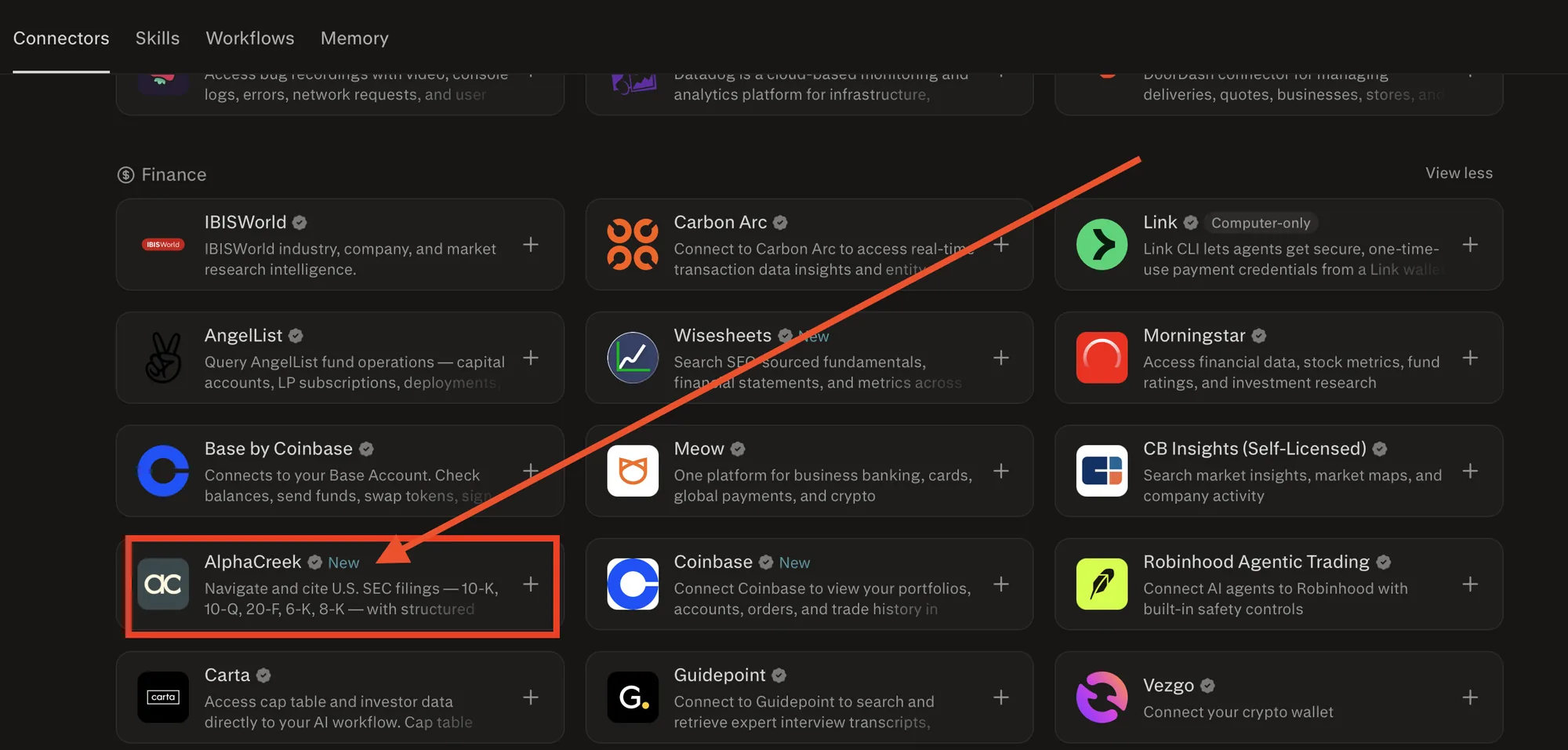
Once connected, try one of the prompts above. A good first test is a question where the exact wording in the filing matters, rather than one that can be answered from a financial data feed.
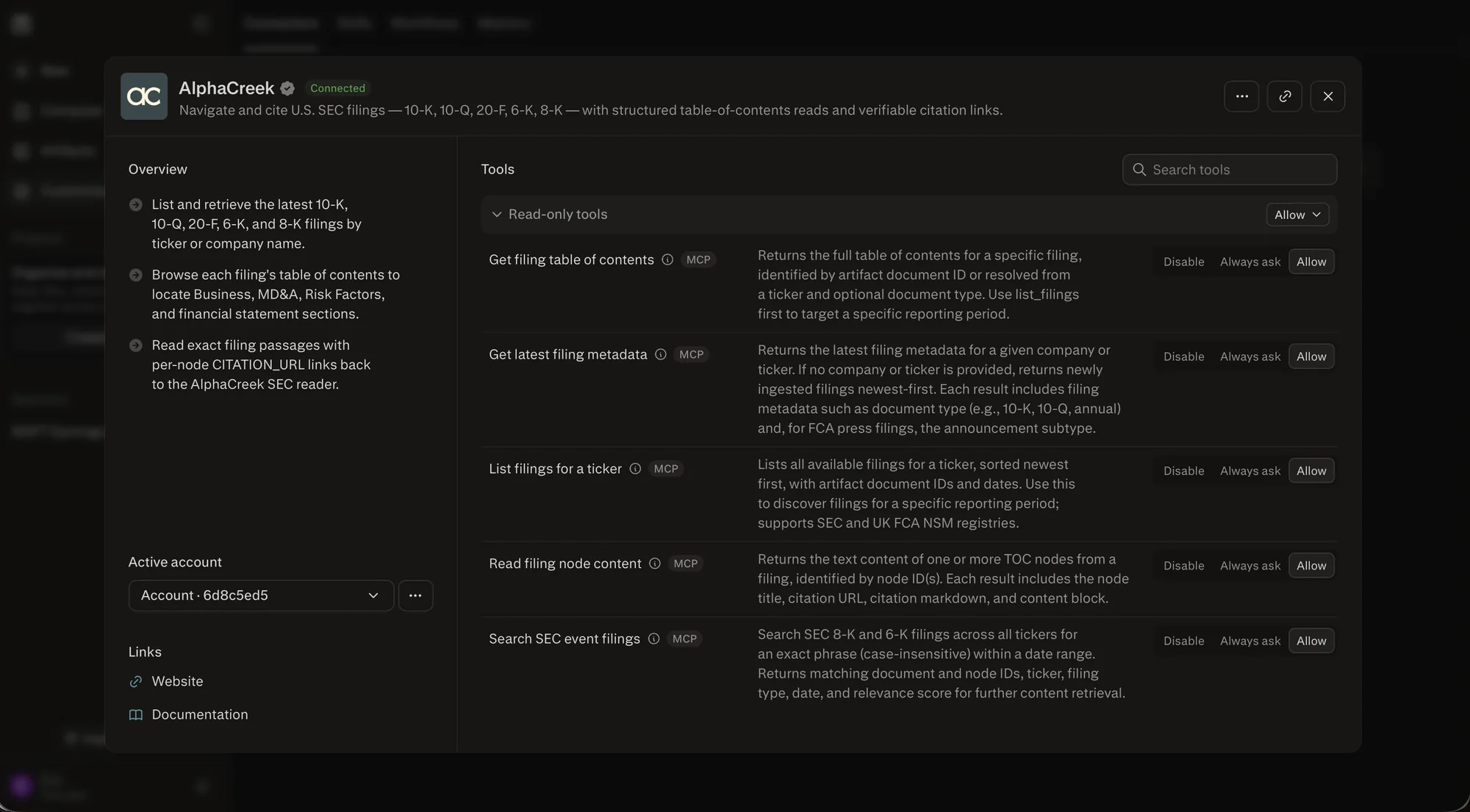 For builders, the same retrieval layer is also available through the hosted AlphaCreek MCP server:
https://mcp.alphacreek.ai/mcp
AlphaCreek also provides a REST API for teams building their own financial AI products.
See AlphaCreek Connect, Build, and Docs.
Frequently asked questions
Do I need a paid Perplexity plan to use the AlphaCreek connector?
Perplexity's March 2026 documentation says custom remote MCP connectors are available to Pro, Max, and Enterprise subscribers. Availability for a specific AlphaCreek connector can depend on how the connector is distributed and your organization's settings.
Does AlphaCreek give Perplexity stock prices or market data?
No. AlphaCreek is focused on regulatory filings and disclosures, not market data such as stock prices, options chains, or quotes.
Which filings are covered, and how fresh are they?
US coverage includes 10-K, 10-Q, 8-K, 20-F, 6-K, and proxy statements across 6,000+ tickers, with ingestion targeted at under 5 minutes after an EDGAR filing. UK coverage currently includes 4,000+ FCA NSM documents across 380 Official List equity commercial issuers as of August 25, 2026.
Can I ask about UK companies too?
Yes. UK FCA National Storage Mechanism coverage has been live since August 18, 2026. The current coverage focuses on 380 Official List equity commercial issuers and selected NSM disclosures.
How is this different from Perplexity just searching the web for a 10-K?
Web search can find the filing. AlphaCreek is designed to navigate the filing structure, retrieve the relevant passage, and return a source link to the passage behind the answer.
Can I use the same data inside my own product instead of Perplexity?
Yes. AlphaCreek provides a hosted MCP server and REST API for teams building their own financial AI products, research applications, and agents.
Methodology and update context
The coverage figures in this post reflect AlphaCreek's available coverage as of August 25, 2026.
The UK issuer figure refers to the current AlphaCreek coverage of 380 Official List equity commercial issuers, with 4,000+ documents retrieved from the FCA National Storage Mechanism.
AlphaCreek will update this post when coverage, supported filing types, or connector capabilities materially change.
Related reading
- AlphaCreek brings citation-grade SEC filing analysis to OpenBB
- FCA NSM filings for AI agents, same MCP as SEC
- How to build an SEC filing agent without naive RAG
- SEC EDGAR MCP benchmark
Get started
For researchers, connect AlphaCreek in Perplexity and run one of the prompts above.
For builders shipping a financial AI product, get an AlphaCreek API key or talk to us about a production rollout.