Can Starlink Reach $40 Billion a Year and a $1 Trillion Value?

David Friedberg says Starlink alone can reach $40 billion in annual revenue and a $1 trillion valuation. SpaceX’s Q3 results and airline SEC filings show the revenue path is on track, while cash margins still need to grow.
Can Starlink Reach $40 Billion a Year and a $1 Trillion Value?
Short answer
David Friedberg is a host of the All-In Podcast. He built The Climate Corporation, a farming-data company, and he now runs The Production Board, which invests in science companies. He does not work for SpaceX. He thinks Starlink alone could be worth about $1 trillion within 18 months. His idea: Starlink earns about $40 billion a year in sales and keeps about $30 billion of that as cash.
The sales part looks reachable. Starlink just had a $5.25 billion quarter, up 22% from Q2. Q2 itself was up 32%. Growth has already slowed to about the pace in the table below. At that pace, it gets to a $40 billion yearly pace by late 2027.
The cash part is harder. This quarter Starlink keeps about 37 cents of each sales dollar after $1.54 billion of new spending. In Q2 it kept about 29 cents. Friedberg’s math needs about 75 cents. New spending rose $176 million, while sales rose about $1 billion and Starlink added 1.6 million customers. In Q2, that spending rose only $35 million.
Friedberg’s idea in four steps
Friedberg shared this view on the August 8, 2026 episode (from 27:29), right after SpaceX reported its Q2 results.
- Start with today. When he spoke, Starlink had 12 million customers paying about $66 a month. It had just made about $4.3 billion in the quarter.
- Keep growing about 20% a quarter. At that pace, sales reach about $40 billion a year.
- Keep most of it. He expects about $30 billion a year to be left over as cash.
- Price it like a subscription business. People rarely cancel Starlink, and it costs little to win new customers. So he says investors could pay 30 times that cash: 30 × $30 billion = $900 billion, or about $1 trillion.
These are his numbers. SpaceX has not given a $40 billion or $30 billion target. The Q3 results below are the next check on his starting point.
Where Starlink is today
In the third quarter of 2026, Starlink sold $5.25 billion of service. That was 22% more than Q2 and 69% more than a year earlier (SpaceX Q3 Connectivity results).
Sales come from two groups:
| Group | Q3 2026 sales | Q2 2026 sales | Growth vs. Q2 | Growth vs. a year ago |
|---|---|---|---|---|
| Homes and individuals | $3.12 billion | $2.49 billion | +26% | +57% |
| Businesses and governments | $2.13 billion | $1.81 billion | +18% | +91% |
| Total | $5.25 billion | $4.29 billion | +22% | +69% |
Starlink is also profitable. It earned $2.37 billion in operating profit in the quarter, up from $1.66 billion in Q2.
Homes and individuals
Starlink had 13.6 million home customers at the end of September 2026. It had 12.0 million at the end of Q2, and 7.2 million a year earlier. It added 1.6 million in the latest quarter.
The average customer pays $69 a month. In Q2 the average was $66. A year before this quarter it was $83. The filing does not say why the average moved.
At $69 a month, 24 million customers would bring in about $20 billion a year. At Q2’s $66 price, the same 24 million customers would bring in about $19 billion. Either figure is about half of Friedberg’s $40 billion. At the latest pace of 1.6 million new customers a quarter, Starlink gets to about 23 million customers in six more quarters. It would need to add customers a bit faster to reach 24 million.
Businesses and governments
Over the past year, this is still the faster group. Its sales rose 91%, against 57% for homes. This quarter, homes grew faster: 26%, against 18% for businesses.
Business sales were $2.13 billion in the quarter, up from $1.81 billion in Q2. At the Q3 level, this group is an $8.5 billion a year business. In Q2 it was a $7.2 billion a year business.
Q2 grew faster than Q3. Sales were up 32% from the quarter before Q2, Starlink added 1.7 million customers, and spending on new assets rose only $35 million (Q2 Connectivity results). That release also says SpaceX:
- signed American Airlines;
- turned on service for Southwest, Virgin Atlantic, Iberia, and Aer Lingus;
- started phone service deals with SoftBank, NTT Docomo, and Spark NZ;
- won more than $6 billion of multi-year U.S. government contracts for Starshield, its defense version of Starlink.
By September 30, Starlink was on more than 3,800 aircraft. SpaceX also counts hundreds of thousands of business subscribers, separate from the 13.6 million home customers. The home-customer growth this quarter came from developed markets (Q3 Connectivity highlights).
What existing customers say
I searched other companies’ SEC filings with AlphaCreek for mentions of Starlink. The airlines tell the clearest story.
Passengers like it much more. United says Wi-Fi satisfaction on its Starlink flights is more than twice as high as on its other flights. Passengers streamed 128,000 hours of live sports on almost 6,000 Starlink flights (United scores).
Airlines are adding it to whole fleets.
- United has Starlink on more than 450 planes. It expects almost 1,000 by the end of 2026 and every plane by the end of 2027 (United fleet).
- Alaska Airlines paid Starlink $98 million in 2025. It has finished its regional planes and plans to finish the rest by the end of 2027 (Alaska fleet).
- Southwest flew its first Starlink plane on June 22, 2026, and plans at least 300 by the end of the year.
Ships are switching too. KVH, which sells internet to ships, grew that business 31% in the quarter. Its CEO said Starlink drove the growth (KVH airtime).
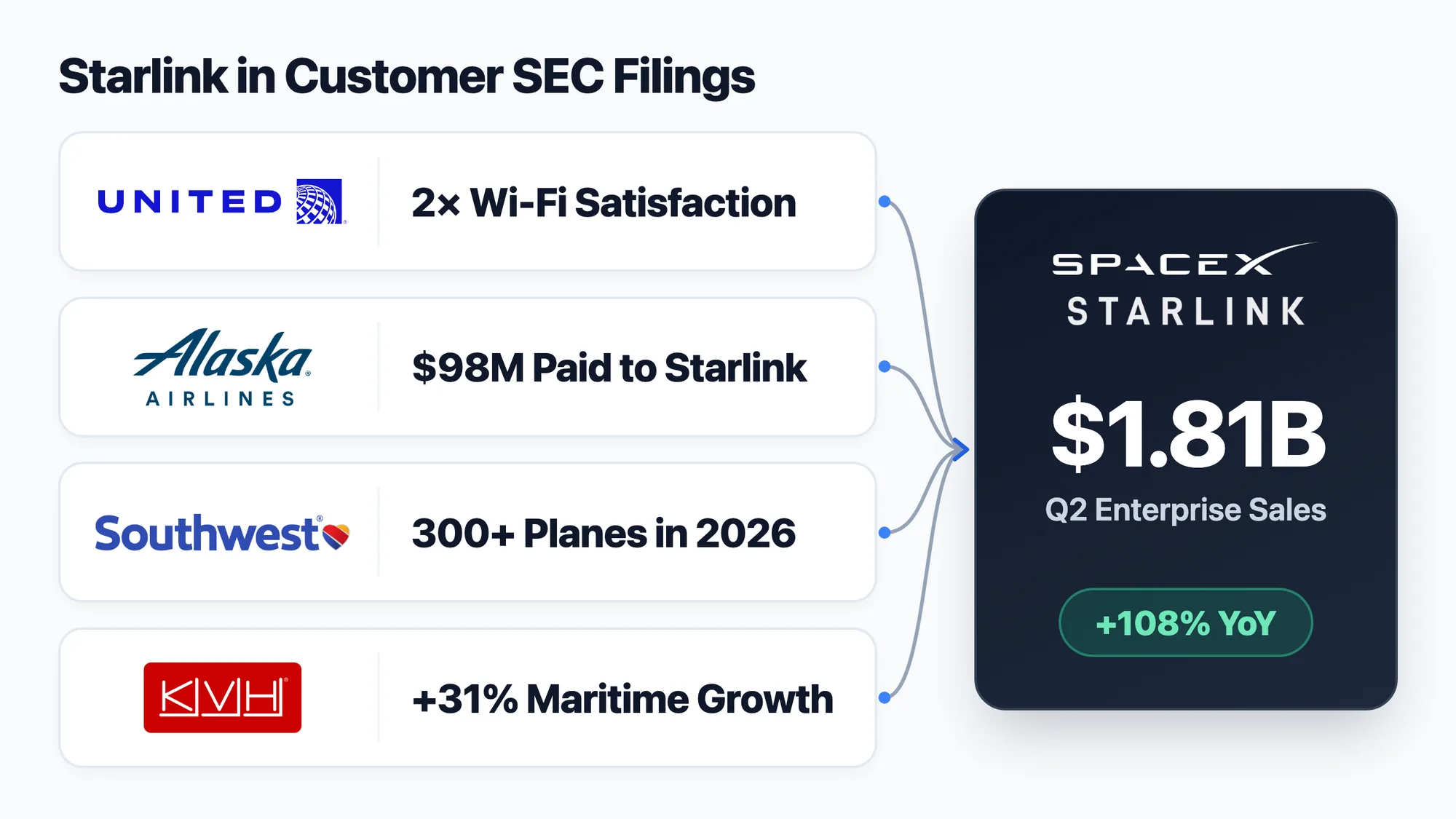
Airline and shipping filings show satisfied customers and install plans that run through 2027. SpaceX later said more than 3,800 aircraft had Starlink by September 30.
How Starlink compares with fiber
Fiber is the better home connection where the cable is already in the street. It is usually faster, steadier, and lower delay. Rain, trees, and a crowded satellite cell can slow Starlink. They do not slow a fiber line in the same way. Starlink wins where that cable does not exist, and on planes and ships. The airline scores above compare Starlink with other airplane Wi-Fi, not with home fiber. Fiber is also cheaper to run per bit in a city, because one cable serves many homes. Starlink is cheaper to bring to a remote house, because there is no trench. The last quarter still fits that pattern. Starlink added 1.6 million customers while spending on new assets rose $176 million, from $1.37 billion in Q2. The average customer pays $69 a month. In Q2 the average was $66. That is a global average. Where fiber is available, the monthly price is often similar, and the fiber plan usually includes more speed.
How it compares with other satellite internet
The older satellite internet companies use a few satellites very far from Earth. Starlink uses many satellites close to Earth. EchoStar, which owns HughesNet, says its main home-internet rivals in North America are Viasat and SpaceX (EchoStar competitors). HughesNet lost about 58,000 subscribers in the first quarter of 2026. Its service sales were $249 million, down 10% (HughesNet results). Viasat says customers are leaving that old model for low-Earth services, including Starlink (Viasat competition). KVH, which sells internet to ships, says Starlink cut its older subscriber base on price, while KVH itself now resells Starlink (KVH competition).
Where the next customers come from
Friedberg does not stop at rural homes. On the same episode, he says the next jump is the phone in a person’s pocket. He says the home business is adding about 2 million customers a quarter, and a service that connects ordinary phones could take that to 4 or 5 million. His example is the United States, which already has about 400 million mobile subscriptions. (Episode transcript, from 28:59)
That sale works differently from a dish on a house. The phone company already has the customer. In Q2, SpaceX started phone-service deals with SoftBank, NTT Docomo, and Spark NZ. Those carriers are in Japan and New Zealand. After Q3, SpaceX agreed to buy up to 14 MHz of paired 800 MHz spectrum for Starlink Mobile. It expects that deal to close in the first half of 2027 (800 MHz spectrum). Airlines do the same job in the air: one contract, then the airline installs the service plane by plane. Ships come through resellers such as KVH. EchoStar has a paid program to send its HughesNet customers to Starlink, and it had started installs for new Starlink customers by the end of 2025 (EchoStar–SpaceX agreement).
So the path has two steps. A home customer orders a dish. A business customer signs once, then brings its own passengers, ships, or phone users. New countries are part of that second step. A phone customer may also pay less than a home customer, so more customers do not automatically mean the same sales per person.
Can Starlink reach $40 billion a year?
Yes, if it keeps growing at about 20% a quarter. Q3 grew 22%, down from 32% in Q2. The slowdown Friedberg’s path needs has already started.
| Quarter | Quarterly sales | Yearly pace (× 4) |
|---|---|---|
| Q2 2026 (actual) | $4.29 billion | $17.2 billion |
| Q3 2026 (actual) | $5.25 billion | $21.0 billion |
| Q4 2026 (at 20% growth) | $6.30 billion | $25.2 billion |
| Q2 2027 (at 20% growth) | $9.07 billion | $36.3 billion |
| Q3 2027 (at 20% growth) | $10.88 billion | $43.5 billion |
That puts Starlink past a $40 billion yearly pace in the third quarter of 2027, inside Friedberg’s 18 months.
The money would come from both groups. About $20 billion from homes, at 24 million customers and today’s $69 price. The rest from airlines, ships, governments, and phone service. Business sales rose 91% in the past year, and the airline plans above already run through 2027.
The main risk is price. The average fell from $83 a year ago to $66 in Q2, then rose to $69. If it falls again, Starlink needs even more customers to reach $40 billion.
Can Starlink alone be worth $1 trillion?
On Friedberg’s math, yes, but only after Starlink keeps much more of its sales as cash.
Here is the gap, using Q3. Q2 is next to it.
- Starlink brought in $5.25 billion. In Q2 it brought in $4.29 billion.
- After running costs, it had $3.50 billion left. In Q2 it had $2.60 billion left.
- It then spent $1.54 billion on new assets. In Q2 it spent $1.37 billion. SpaceX does not say how much of that was satellites, dishes, or ground stations.
- That left $1.96 billion of cash, or about 37% of sales. In Q2 it left $1.23 billion, or about 29% of sales.
Friedberg’s $30 billion of cash on $40 billion of sales is 75%. The latest quarter is closer than Q2. It is still well short of 75 cents. Starlink does not need one new satellite for each new customer to get there. Over the past year, home customers rose from 7.2 million to 13.6 million, while quarterly spending on new assets rose from $1.01 billion to $1.54 billion. In Q3, sales rose about $1 billion and that spending rose $176 million. In Q2, spending rose only $35 million.
There is still a limit. A home dish and a full airline do not use the same amount of capacity. SpaceX is building its next satellites, called V3, because it expects them to carry much more data than the ones up now. Starship is how it plans to launch them for far less. In the Q2 release, launch sales were up 29% from a year earlier, and SpaceX said it believes Starship can cut the cost of reaching orbit by 99% or more compared with the past (Q2 Space segment). In Q3, Starship Flight 14 was the first orbital flight. It carried 26 of these newer satellites. SpaceX says that load added about 10 times the downlink of one Falcon 9 Starlink launch. Costs in the launch segment were also up $367 million from a year earlier, as SpaceX continued to accelerate Starship research (Q3 Space highlights).
Cheaper launches matter when today’s satellites fill up. Flight 14 added a block of new capacity. It does not close the cash gap by itself.
The other two segments
Cash after spending, in the table below, is what is left after running costs, minus new spending. SpaceX does not report that line under this name. Q2 used the same method.
| Segment | Q3 2026 sales | vs. Q2 | vs. a year ago | Left after running costs | New spending | Cash after spending |
|---|---|---|---|---|---|---|
| Starlink | $5.25 billion | +22% | +69% | $3.50 billion | $1.54 billion | +$1.96 billion |
| Space (launches) | $1.77 billion | +84% | +6% | $0.36 billion | $1.61 billion | −$1.25 billion |
| Super Intelligence | $7.56 billion | +195% | +830% | $4.95 billion | $16.44 billion | −$11.49 billion |
Starlink is still the only segment that makes cash after new spending (Q3 segment results). In Q2 those cash figures were +$1.23 billion for Starlink, −$1.38 billion for launches, and −$14.68 billion for the computing segment.
The Space segment sells launches. Sales rose 84% from Q2, but only 6% from a year ago. This quarter the segment had $0.36 billion left after running costs. In Q2 it lost $0.21 billion before new spending. It still spent $1.61 billion on new assets, so cash after spending was negative. Most of its rockets still fly for Starlink. In Q3, 23 of 35 launches were SpaceX’s own. In Q2, 28 of 38 were its own (launch counts).
The computing segment is now called Super Intelligence. The Q2 release called it AI. Its sales rose from $2.56 billion to $7.56 billion. SpaceX points to new deals that rent computing power, the Cursor purchase, and more use of Grok. It had $4.95 billion left after running costs, up from $1.15 billion in Q2. Operating profit was $431 million, because that profit includes $1.2 billion of share pay from the Cursor deal. Computing power grew from 1.4 gigawatts at the end of Q2 to 1.7 gigawatts. A year earlier it was 0.6 gigawatts (Super Intelligence highlights).
SpaceX completed the Cursor purchase on August 14, 2026, at a $60 billion equity value. Cursor added $608 million of sales from the close through September 30 (Cursor merger). In Q2, before that close, SpaceX had signed $14.1 billion of computing deals (Q2 AI segment). The Q3 release says it signed more of those deals. It does not give a new total.
Together, the three segments used about $10.8 billion more cash than they kept. In Q2 the gap was about $14.8 billion. SpaceX reported a $4.4 billion profit for Q3. Profit does not subtract the full cost of new assets in the quarter they are bought (Q3 results). SpaceX covers the cash gap from its cash pile. Cash and marketable securities were about $90 billion at September 30 (balance sheet). At the end of Q2 they were about $100 billion (Q2 highlights). Friedberg says Starlink’s cash can fund much of the rest of SpaceX. This quarter, Starlink’s $1.96 billion covers about 12% of Super Intelligence’s new spending. In Q2, Starlink’s $1.23 billion covered less than a tenth of that spending.
Bottom line
Starlink can reach $40 billion a year if quarterly growth stays near the 22% it just reported. Q2 grew faster, at 32%. Customers are still growing, the average payment rose from $66 to $69, and airlines report happier passengers and fleet-wide rollouts. A value of about $1 trillion for Starlink alone still needs much more cash per sales dollar. The latest quarter improved that from 29 cents to 37 cents. Friedberg’s math needs about 75 cents. Flight 14 put more capable satellites in orbit. The rest of the cash gap depends on adding that capacity at a much lower cost.
Try the tool behind this article
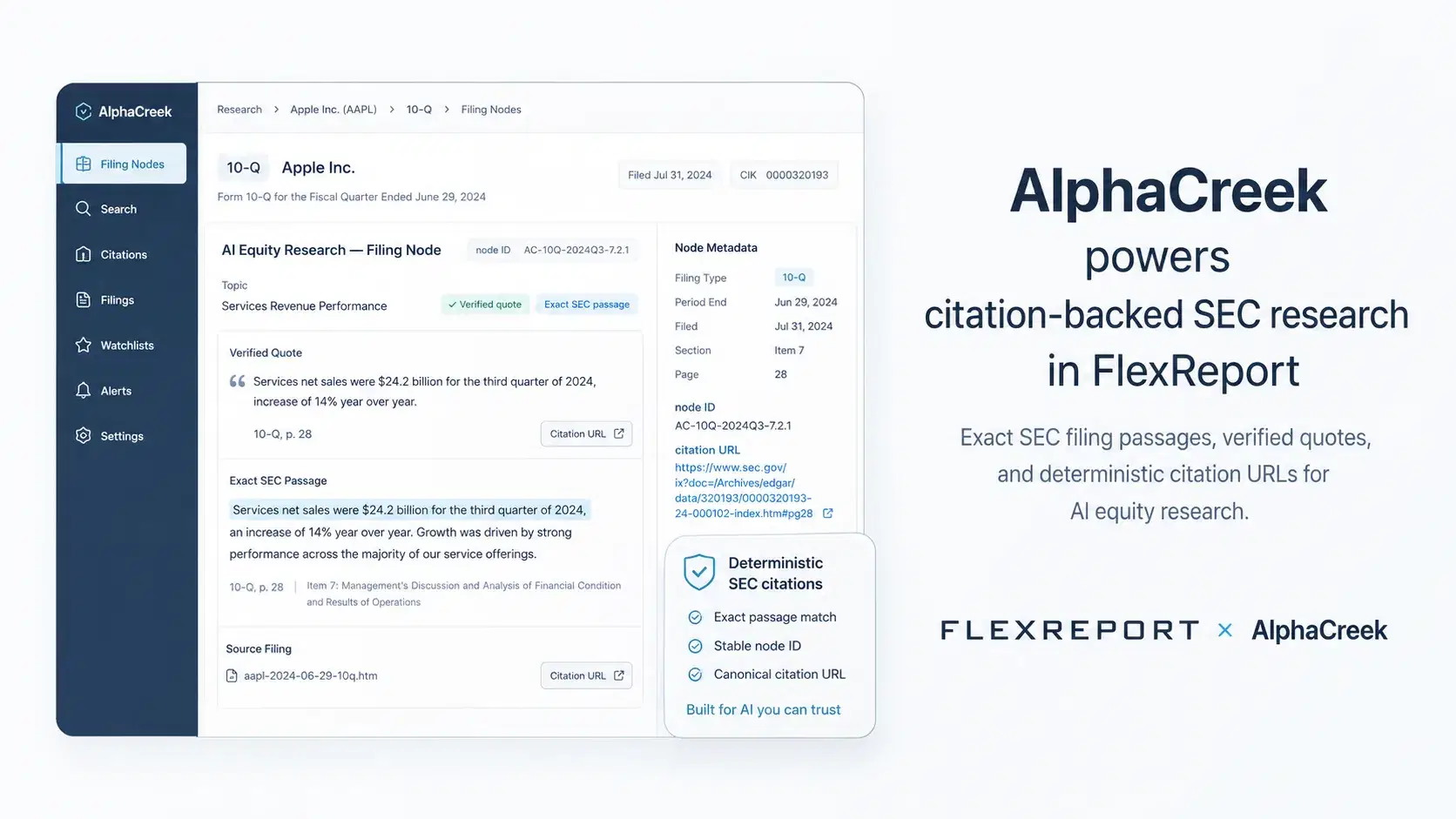
I wrote this article using AlphaCreek MCP, which lets AI agents search through thousands of SEC filings and make citable, verifiable claims.
Every filing number and customer quote above — from SpaceX’s Q3 report and the Q2 comparisons to the Starlink rollouts at United, Alaska, Southwest, and KVH — came straight from AlphaCreek MCP with a direct link to the source passage.
- Connect AlphaCreek MCP → — Use it in Claude, ChatGPT, Perplexity, or Cursor in under a minute.
- Build with the MCP API → — Plug cited SEC and UK FCA filings into your own AI agent (Python and JavaScript).
- Read the MCP docs → — See the tools, search queries, and citation links.